Showing posts with label George Edward Stanley. Show all posts

Friday, August 9, 2019

George Edward Stanley

One Final Step is George Edward Stanley’s last published book set in anything resembling the original Hardy Boys continuity. He published a few Hardy Boys Secret Files books after Final Step, and he wrote a pair of Hardy Boys books that weren’t published and don’t have a date in the University of Southern Mississippi’s George Edward Stanley Papers guide. One of the unpublished books was written originally for the later Undercover Brothers series with the original title Living with Blue People; the title morphed to Desert Danger and finally to Sahara Oil!, but Living with Blue People is as nearly as perfect an encapsulation of Stanley’s Hardy Boys work as can be imagined. Like his Hardy Boys books, the title is inexplicable on its own and completely clashes with the Hardy Boys style and tone, and I can’t read it without thinking about how bad it is.

I’ve been hard on Stanley, but that’s only because his Hardy Boys books are awful. But that’s just his Hardy Boys books! He wrote literally dozens of other children’s books, as evidenced by the archived version of his faculty web page; some of his works written under pseudonyms, like the digest Hidden Mountain (#186) and his Secret Files work, aren’t even included. He was a professor of African and Middle-Eastern languages and linguistics at Cameron University, a state college in southwest Oklahoma. Another biography has more astonishing information: He earned a doctorate in literature! He was inducted into the Oklahoma Writers Hall of Fame in 1994! He was a member of the National Council of Less-Commonly Taught Languages, which isn’t that prestigious, but it’s fun to know! He taught creative writing to others! He was a working writer that publishers turned to, time and again!

George Edward Stanley, who passed away in 2011, had an amazing career. His family and friends should be proud of him, regardless of what I say about him. I mean, his Hardy Boys stories are poor, which is disappointing, given that reading the Hardys and other juvenile series inspired his writing career, but that’s just one aspect of his impressive life. The rest of his career extended far beyond most people’s achievements.

Friday, August 2, 2019

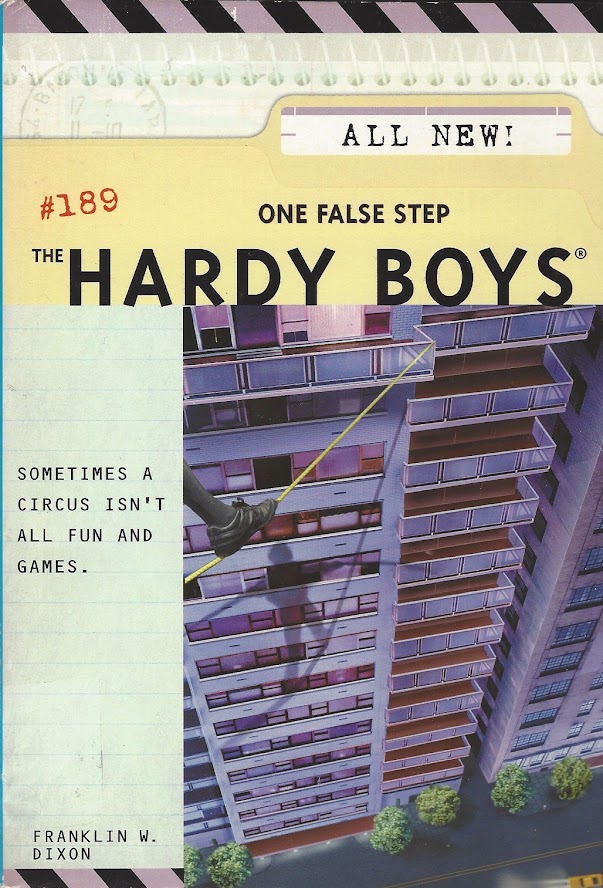
One False Step (#189)

One False Step coverI approached the penultimate Hardy Boys digest, One False Step, with some trepidation. George Edward Stanley, who wrote One False Step, had also written two of the worst books in the digest series (The Case of the Psychic’s Vision, #177, and Hidden Mountain, #186). What if One False Step lived up — or down, if you want to think of it that way — to that standard? Or would it be worse if it didn’t?

Well, One False Step is not in the same class as Psychic’s Vision or Hidden Mountain, for ill or for good. It’s obviously a Stanley story; it has the weird level of unimportant details that Stanley must feel gives depth to the story but just ends up being strange. Do we care Aunt Gertrude is reading a romance novel, The Bride from Butte, that has been written by the granddaughter of one of Gertrude’s college friends? No. Why would we? Neither the book nor its author pops up again. Do we care Callie has an identical (but distant) cousin, Mary Beth Edwards, in New York? Well, kinda, but Mary Beth doesn’t show up at all; she’s just a passing mention, a robbery victim whom Frank and Joe hear about but never talk to. I understand naming the Bayport High School cafeteria lady, Mrs. Conroy, but her banter with the Hardys and their chums is a waste of page space.

And then you’ve got Frank and Joe’s new next-door-neighbor and friend, Matt Jenkins. (No mention of whether his family replaced the Forsythes, mentioned in The Mystery of the Chinese Junk [#39], or if they moved in on the other side.) He never turns into a Larry Stu the way Colin Randles does in Psychic’s Vision, but we learn all sorts of irrelevant detail about him: He lived in Botswana, his father was a well-known mystery writer who died of cancer, his mother is a diplomat, and he wants a “normal American high-school experience” (8) like seeing Aerocircus, a weird circus that sells tickets at more than $200 a pop. None of that is relevant, except for the last one, as Matt drags Frank, Joe, Chet, and Tony to Philadelphia at the last moment to see Aerocirque, without first securing tickets.

Well, Matt also uses his Africa sense when Joe doesn’t read the chapter in his history book on apartheid; Matt gives him a lecture on the subject, which he knows about because he lived in Botswana and “apartheid affected all the surrounding countries” (3). That’s like a Canadian telling a Russian about Jim Crow legislation because, hey, Canadians are like Americans and right next door. Still, Joe says, “I should get an A on that test!” (3), and Frank says, “I learned a lot of things about that time too” (3).

That Frank ended that statement with “fellow kids” should be understood, even though it’s not on the page.

Stanley’s handling of the supporting cast is a mixed bag. Chet in included only so everyone can make food jokes, which is standard for a Hardy Boys story, and even though that should be condemned (to an extent), I also don’t want to talk about it. Tony Prito is added to the boys’ trip to Philadelphia because … because … I don’t know why, honestly. I don’t know why the expedition needs a fifth boy, and Tony adds nothing to the story; they don’t need his muscle or knowledge or even his mass as ballast. He doesn’t even use his Italian heritage and food-service experience to complain about / laud Philly cheese-steak sandwiches or hoagies or Italian roast-pork sandwiches or water ice (aka “Italian ice”) or strombolis. I had to double check to make sure the fifth boy wasn’t Phil Cohen or Biff Hooper or Jamal Hawkins. I’m still not entirely sure Stanley was consistent throughout — not because I doubt Stanley’s ability to get the name right but because it didn’t matter.

Girls, on the other hand, fare better. Iola gets in cutting remarks about Callie’s overachieving nature and her brother’s comic-book collection. Callie appears only momentarily, delivering the news of her cousin’s robbery. Gertrude is teased about whether wedding bells are in the future for her and her friend, Mr. Phillips. (The last time Gertrude had a possible romantic entanglement, it was with Clayton Silvers in Past and Present Danger, #166.) The girls in Philadelphia like the boys, or maybe boys in general; when local girls party with the Hardys and their chums, the boys are never lacking in dance partners, and Tony picks up digits from many of them. The girls ask the boys to tell them about Bayport, which … well, where do you start? (After that, Elisabeth, the hostess of the party the boys go to, points out how rich her female friends are, which confuses Frank and Joe, but I think she confused the word “sleuth” for “gigolo.”) Later, Frank and Joe get a couple of girls to show them some Philadelphia “hospitality,” if you know what I mean.

(What I mean is “historical sites” and “lunch at an exclusive restaurant.”)

In Philadelphia, Frank, Joe, and their friends are allowed to stay with one of Fenton’s contacts, Det. Mario Zettarella, and his wife, Gina. Five teenage boys are a lot to have dumped into your house at the last moment, but the Zettarellas don’t mind; they have five grown boys, and Gina enjoys nothing more the feeding and care of teenagers. She was a stock trader for a brokerage before she married Mario, but raising a family — and cooking! — is more fulfilling for her. Why, even with her children out of the house, she doesn’t consider returning to a brokerage! (This is important, but Stanley doesn’t mention it again.)

Frank and Joe say this is their first time in Philadelphia, but that’ s not true. In Shield of Fear (#91), Frank and Joe helped their father expose organized crime and corrupt officers in the Philadelphia police. (This will become important later — or would have, if anyone had remembered it.) They passed through Philadelphia in the revised Secret Warning (#17), Twisted Claw (#18), and Short-Wave Mystery (#24) and the original Secret of the Lost Tunnel (#29), but Frank and Joe don’t do anything there. Interestingly, the Hardys will return to Philadelphia two books later, albeit in a different continuity, in Extreme Danger, the first Undercover Brothers book.

The only mystery in One False Step is whether everyone in the book is brain damaged, or if we’re supposed to pretend they aren’t. The Mary Beth’s family’s high-rise apartment is robbed, an impossible crime with only a few strange marks left on their balcony. The Edwardses weren’t at home because they were at a performance of Aerocirque, the Cirque du Soleil ripoff that uses helicopters to support the tightropes and trapezes.

(I admit, that level of precision flying and acrobatics is impressive; I don’t believe helicopters could remain reliably steady long enough to support the equipment, and tying two helicopters together sounds horribly dangerous. I also imagine multiple helicopters inside a stadium would produce hearing-destroying levels of decibels. Still, I’d probably go see it.)

Anyway, an impossible robbery of a high-rise apartment should suggest daring, high-altitude acrobatics acts faster than you can say “Wallenda,” but no one makes the connection in New York. No one in Philadelphia makes the connection to Aerocirque when another high-rise apartment is robbed in an identical matter, even though Mario is working security at Aerocirque and is called to the robbery as soon as the show is over. (His position is the only way the boys were able to get into Aerocirque, which is mighty convenient!) The police instead waste their time interviewing fired chauffeurs. Frank and Joe make the connection eventually — not after any epiphany or discovering new evidence but after seeing Elisabeth, the daughter of Aerocirque’s founder, point at apartment buildings while talking to an acrobat.

The brothers tell Mario, and he inserts them into the high-wire troupe that is going to pull the robbery. (These acrobats are all masked mutes, so the impersonations are not as difficult as one might think.) Frank and Joe are supposed to be anchors for the tightrope walkers who will cross over a street to a penthouse from an office building across the street, but one of the two tightrope walkers twists his ankle getting out of their helicopter. After the cable is fired across the street and anchored on their end, Frank and Joe are given the codes for the penthouse’s security and signaled that they must make the crossing. Walking the wire to the penthouse is no problem for the boys, since they do high-school gymnastics and have spent the day training with the troupe, but when they get to the penthouse, the security details they have are for the wrong manufacturer.

Mario and his men are inside the penthouse, so Mario tells Frank and Joe to walk back over and mime to the other two tightrope walkers what the problem is. The police need time to get over to the other building to arrest the thieves before they board their helicopter and escape. Why the police wouldn’t already be in position, given that they had the time to do so while Frank and Joe were walking over in the first place, is beyond me, but …

Well, there’s no “but,” really.

So Frank and Joe walk back over the tightrope. It’s a little more difficult this time, but Stanley makes sure to bleed the scene of most of the tension. When the Hardys complete their second tightrope walk, they find the two acrobatic thieves not only knew who Frank and Joe really were, but they’re not even mutes. The thieves subdue the boys and load them into the helicopter, planning to dump them into the Atlantic, but Elisabeth, the daughter of their legitimate and criminal boss, calls them back; she’s OK with robbery because they need money, but murder is too far. Frank and Joe are locked in a penthouse, where Mario tells them he figured out Aerocirque was behind the robberies before the Hardys did, and he told the gang / Aerocirque leader he had to cut Mario in, or he was going to jail. Mario then leaves.

After she’s left alone with the captive Hardys, Elisabeth tells them everything else. Because Frank and Joe are held in the room where the gang stores its equipment — the storage area is hidden, but keeping Frank and Joe in the same room is still a bad idea — Elisabeth is able to fire one of the cable bazookas, and Frank and Joe make one last high-wire walk. Belatedly, we learn a member of the United States Olympic Committee has told Joe “if [Joe] kept at it, he could make the [gymnastics] team in 2008” (143). Seems like we should have heard about that sort of astounding c.v. earlier!

The gang cuts the wire just before Frank makes it across, but he catches the wire, and a friendly woman lets him and Joe into her apartment. It wouldn’t be a Stanley story if we didn’t learn completely irrelevant and boring information about the woman, Louise Schuster. “She tries to help wayward teenagers,” Frank says (147), and I weep for whatever editor worked on this book.

From there, Frank calls the FBI. Mario is arrested — he did it “for the money” (130-1), which suggests that if his wife had gone back to work, he might have remained honest — as are two of his officers, the Aerocirque acrobats, and Elisabeth. Her father escapes to the Caribbean, presumably with all the money. Crime does pay! The book ends with Matt suggesting Frank and Joe walk a tightrope as a school fundraiser; despite having decided never to walk the wire again, Frank and Joe give in to teasing and peer pressure.

This moment of lightheartedness allows us to forget Gina, whose life has been ruined by the Hardys intrusion. Frank and Joe do not see her after their abduction, and Tony, Chet, and Matt slink away. Callow teenagers!

One False Step is a poor story; an ungenerous yet still accurate assessment would be that it’s a very poor story. The digest series is littered with stories that plumb the depths of narrative ineptitude, and I’m disappointed Stanley would not crash beyond this low-water mark to give readers something sublimely ridiculous or ridiculously sublime. This was Stanley’s last chance to challenge Dr. John Button for the title of worst Hardy Boys writer, and he failed at it. That he didn’t fail by succeeding is an altogether appropriate capstone for his Hardy Boys career.

Friday, June 21, 2019

Hidden Mountain (#186)

Hidden Mountain coverI’ve breezed my way through these digests, and by and large, they’ve blurred as I passed them by. Some of them I have a hazy-but-fond memory of, some I vaguely recall disliking, but most blend into a flavorless paste that disappears into the wrinkles of my brain. Occasionally, I have stumbled across something like The Secret of the Island Treasure (#100), one of the best digests, or The Case of the Psychic’s Vision (#177), which spectacularly misjudges what a Hardy Boys book should be. Nothing comes close to the disasters like the original Disappearing Floor (#19) or Flying Expess (#20) or triumphs like the original House on the Cliff (#2) or Mystery of Cabin Island (#8).

Hidden Mountain is more Psychic’s Vision than Flying Express, but this book is closer to catastrophe than you might think. (Like Psychic's Vision, Hidden Mountain is written by George Edward Stanley, according to the University of Southern Mississippi's libraries' archives.) Hidden Mountain doesn’t have Flying Express’s continuity errors or Disappearing Floor’s ludicrousness; rather, Hidden Mountain has a strange idea of what makes a Hardy Boys story a Hardy Boys story. Had this been an adventure of the Generic Teen Detectives — well, if it had been an adventure of the Generic Teen Detectives, I wouldn’t have been reading it, because “Generic Teen Detectives” is a horrible name for a mystery series. But if it had been part of that series, and I had read it, I wouldn’t have liked it, but I wouldn’t have found it so awful either.

To start off with, Hidden Mountain posits a group of teens who don’t feel like the Hardys and their friends. Neither Frank nor Joe is in a “serious relationship” (1), and they date Callie and Iola only “from time to time” (1). The Mortons live in an older part of Bayport, which I suppose is the new status quo, but it still feels weird — and honestly, I feel the Mortons should live in a newer development, as refugees from rural poverty. At the Mortons’ home, Chet complains about all the food his mother has made, saying, “‘Good grief, Mom!’ Chet cried. ‘You’re not feeding an army!’” (7). It’s a bit like Cookie Monster labeling cookies a “sometimes food” — perhaps for the best, but weird and wrong at the same time.

Plus, Chet owns a shortwave radio.

The shortwave radio used to be a vital part of the Hardys’ crimefighting arsenal, but with the advent of cell phones, the shortwave radio lost its importance; the radio (called a “ham radio,” which is more or less the same) was last mentioned in The Blackwing Puzzle (#82), as far as I can tell. Here, though, the narration reframes radio’s role in the Hardys’ lives: Joe “and Frank had solved a couple of mysteries that involved shortwave, but it was almost always the bad guys who used them” (10). Boo! If Stanley had reframed shortwave as a Hardy thing — Fenton or Gertrude with an old set in the attic, or a childhood hobby Frank and Joe set aside but Chet seems have mastered — I would have been supported or even lauded the decision. But no, shortwave radio is no longer cool enough for Frank and Joe to have ever used.

Anyway, Chet gets a message over the shortwave from Darren Wilkerson, a former classmate who left Bayport suddenly with his family. Darren is in trouble in Hudson’s Hope, British Columbia, Canada, and he needs Chet to get a message to Frank and Joe — but the transmission is cut off before Darren can get off more than a request for help. If I had more confidence that this Dixon and his editor knew the series’s history, I would suggest this book was homaging to The Short-Wave Mystery (#24), a book which involved shortwave radio and a trip to Canada. (And during which Frank killed a lynx with a radio antenna, while Chet took up taxidermy. These were two completely unrelated events.)

After Fenton pretends to exercise parental oversight over the boys, he gives in, arranging for backup in Hudson’s Hope and buying Frank and Joe hiking / mountaineering equipment. Once the boys’ “school vacation” (13) begins* two days after the shortwave call, they are off to Canada, flying from LaGuardia to Edmonton to Dawson Creek, B.C. — a real city of 11,000, not the place named after a James van der Beek character. At this point, the book becomes filled with weird details that go nowhere.

Gertrude laments over a friend in Wisconsin whose house has burned down, and the house was uninsured because her husband might have Alzheimer’s. Neither Wisconsin nor Alzheimer’s (or any other form of dementia) come up again; for that matter, neither does Gertrude. Chet can’t come with Frank and Joe because Mrs. Morton has decided to redecorate the house in “New Mexico style” (19), so she’s going to New Mexico and needs Chet to schlep paintings around. Chet frequently has lame excuses to avoid adventures, but this is a strange yet strangely detailed excuse. At LaGuardia, Frank and Joe inexplicably meet their old babysitter, Annie Wilson, who is working for the airline, and she fawns over them; on the plane to Edmonton, two flight attendants (Bonnie and June, rather than Benny and Joon) give the boys an extra meal each and stop barely short of flirting. This sounds like an airplane fantasy, although that may be because I don’t believe an airplane would serve an in-flight meal, let alone a steak dinner with anyone getting an extra portion, after 2001.

(Flying through Edmonton reminds me of The Viking Symbol Mystery, #42, a clunker that deserves more vitriol directed at it for having the boys casually rack up 5,000 miles of travel in Canada in less than two weeks, flying from Calgary to Saskatoon to Edmonton to Fort Smith, over and over again. At least in that story, Fenton was supervising them from the same province.)

In Dawson Creek — again, a real place — Fenton’s “good friend” (13), Rupert Kitimat, meets the boys when they get off the plane. Rupert is supposed to be a private detective, but the book frequently refers to him as “Detective Kitimat.” That title is almost never used for private detectives; “Detective,” as a courtesy title, is reserved for police detectives. Plus, there’s the question of who’s paying for Rupert’s time? If it’s Fenton, he’s running up a hell of a bill; if Rupert is donating his time, then Fenton must be one hell of a friend.

Anyway, the boys and Rupert take a pontoon plane to Williston Lake, a short-but-rugged hike from Hudson’s Hope. This flight disturbs the boys even though they were certified to fly seaplanes in Viking Symbol. Honestly, it’s like this book doesn’t care about the 75+ years of stupid continuity! Frank, Joe, and Detective Kitimat hike into town over rugged hills, encountering a bear, despite perfectly good roads linking Williston Lake and the town. Anyway, when they get to Hudson’s Hope — surprisingly, it too is real, although it has only about a thousand people — Darren and his family are gone, and a couple of men break into their cabin, shooting at Frank and Joe as the boys flee.

When the men catch up with Frank and Joe, we learn the meat of this stupid, stupid plot:

1) The Wilkersons are part of the Witness Protection Program,
2) But their cover was blown in Bayport — the fourth time this has happened — so the family is hiking across the wilderness to the ultra-secret Witness Protection fortress, Hidden Mountain;
3) Hidden Mountain is in Canada, despite being a haven for people in the US Witness Protection Program, which I admit is probably an effective place to hide them — I certainly didn’t expect the US to keep vulnerable, valuable witnesses in a foreign country, because it’s a stupid thing to do;
4) The two men who shot at Frank and Joe claim to be FBI agents, sent to help the Wilkersons to Hidden Mountain, even though
5) They are so obviously not FBI agents, and the Witness Protection Program is run by the U.S. Marshals Service, which is an entirely different agency that predates the FBI by almost a century and a half;
6) Frank and Joe (especially the former) are able to track the Wilkersons through skills gained through a lifetime of summer wilderness programs, including a summer spent in Oklahoma with another of Fenton’s “good friends” (92), a Kiowa lawyer named George Long Bow;
7) When the Hardys finally shed the two fakes, they run into real FBI agents — again, WITSEC is run by the Marshals Service — and Kitimat, but the fake agents blunder into the Wilkersons;
8) Before the Hardys and the FBI agents can put a plan together, one of the FBI agents is “badly mauled” (101) by a bear and the other injured, evidently suffering a head injury so bad he’s amazed by a travois;
9) But don’t worry about the bear — the FBI agents are allowed to run around a foreign country unsupervised, but they aren’t allowed to kill wildlife, so one of the agents shoots the bear with a “special tranquilizer” (101) that puts the bear into “a twenty-four hour hibernation” (101);
10) So while the FBI agent is pulling his mauled partner toward safety, Frank and Joe insinuate themselves back into the Wilkersons’ / fake agents’ group, even though
11) They have no plan about how they’re going to take care of the fake agents, so the boys are inert as they get closer to Hidden Mountain, not attempting to overpower the fake agents or escape them, although I suppose
12) Escaping would be useless, since the villains have the map to the ultra-secret location that was given to the Wilkersons by some moron, and the villains want to kill all witnesses, so
13) Frank and Joe open a sealed envelope the non-mauled agent gave them, which gives them orders that are kept from the readers;
14) But I suppose the subtlety is best kept from the readers, as the directions are “rocks fall, kill everyone,” which is relevant because
15) To get into Hidden Mountain, everyone must climb the mountain, which means, SCREW YOU, DISABLED OR INFIRM WITNESSES;
16) After getting themselves and the Wilkersons to an overhang while rocks do kill the fake agents and gaining entrance to Hidden Mountain, the Hardys need special permission from Hidden Mountain’s “Supreme Council” to be allowed to leave (138), but
17) They gain that permission to leave because even thousands of miles away from Bayport, in the lost wilderness of Canada, Fenton Hardy’s name opens doors, which is good
18) Because I have no idea how the Canadian or US government resupplies a hidden facility, hundreds of miles from a city of any real size, that has a fifty-mile no fly-zone around it (forgot to mention that) and can be accessed only via mountain climbing, but
19) The story isn’t over, because once back in Bayport, the Hardys are followed by organized-crime figures, and once the FBI arrests those, they announce Frank and Joe will be under FBI “around-the-clock surveillance” (153) for the foreseeable future. Hope Iola and Callie find government surveillance a turn-on, or dates with the girls will go from occasional to nonexistent!

Hidden Mountain is intensely stupid, but its worst failing is that it can’t commit — like these Hardys, who aren’t in a serious relationship. Detective Kitimat follows the Hardys through the Canadian wilderness, but he does nothing to help them or the Wilkersons. The FBI agents show up, ostensibly to help (or take control — this is their moronic operation, after all), but they ignominiously are forced from the book by a bear attack, having done jack squat. They shoot the bear, but they can’t hurt nature’s killing machine; the agents must use stupid, science fictional tranquilizers that will put bears into hibernation for 24 hours, regardless of the size of the bear. The Hardys aren’t willing to hurt the fake FBI agents as they approach Hidden Mountain, even though they know the plan at Hidden Mountain is to kill them; they could have saved the men’s lives by trying something, but they’re willing to let them die rather than, you know, try.

I’m sure I’m leaving out a dozen moronic details — in Hudson’s Hope, for instance, the Wilkersons were warned they’d have to leave by a traveling salesman, which would be the opposite of an inconspicuous way to communicate anything in 2004 in a town of about 1,000 people — but I trust you get the idea: Hidden Mountain is a product of a line and era that often feels like watered-down Hardys, but this book’s stupidity is full strength.

* Which school vacation? The boys are out of school for only about a week, which suggests Spring Break or Easter Break or some sort of fall teacher’s conference, but in Canada, daylight continues until 11 p.m. That must be some time near summer — June, at least — but what occasion results in a week’s vacation from school in June? Even those poor unfortunates who go to school year-round get longer between the end of one term and the beginning of the next, surely.

Friday, April 26, 2019

The Case of the Psychic's Vision (#177)

The Case of the Psychic’s Vision coverThe Case of the Psychic’s Vision is a weird one, and that’s not meant as a compliment.

First, it presupposes that psychic powers are real, and not in a nebulous or deniable manner; psychic powers can reveal that which is hidden or forgotten. Real psychics are the rule, although the existence of fraudulent ones is acknowledged. Second, Fenton not only believes in these psychics but thinks they have probative value in investigations, both public and private. (They do not, of course.) Third, the Dixon writing Psychic’s Vision posits that everyone’s latent psychic abilities can be developed.

Wikipedia says Psychic’s Vision was the first of four Hardy Boys digests written by George Edward Stanley, although [CITATION NEEDED]. (The University of Southern Mississippi has Stanley’s papers, and the collection lists manuscripts and accompanying correspondence for Psychic’s Vision, The Mystery of the Black Rhino [#178], and The Secret of the Soldier’s Gold [#182], which would seem to settle the matter for those books; no mention is made of a manuscript of One False Step [#189]. ETA on 8 June 2019: The Southern Mississippi archive page also lists Hidden Mountain, #186, as one of his works.) Stanley wrote dozens of juvenile stories, including five Nancy Drew books, the Third Grade Detectives series, and the Spinetinglers series, the latter under the pseudonym of M.T. Coffin. Weld those last two together, and you can see how Psychic’s Vision might have come together.

In an interview, Stanley mentioned reading Nancy Drew, the Dana Girls, and the Hardy Boys as a child, and that inspired him to be a mystery writer. Stanley was born in 1942, so the Hardy Boys books he read would have been the original texts of the canon. That influence is visible in Psychic’s Vision. Chet is back to being a prankster, like in the early days; the author remembers the Hardys live at the corner of High and Elm (which shouldn’t be hard to remember, but, well …). The Hardy name gets a new pal excused for being late to class and causes a Vermont police officer to tell a bunch of kids everything about an ongoing hostage situation. A plot point in which a wealthy man pressures an employer to fire certain employees or risk financial ruin seems straight out of the first decade of the series. The book references early mysteries as well: “We got this airplane-shaped trophy when we solved a mystery at the airport … and we got this car-shaped trophy when we found out who was stealing all of the cars out on Shore Road” (44-45). These are clear references to The Shore Road Mystery (#6) and The Great Airport Mystery (#9), although they received trophies in neither book. Still, it’s a better way to shoehorn references to old mysteries into the book than most.

The psychic angle is an element that could have existed in the early books; certainly the original Disappearing Floor (#19) has events far less believable than psychic phenomena, but on the other hand, a fake psychic seems to be the kind of nonsense the Hardys would fight against — like they fought against a quack eye doctor in the original A Figure in Hiding (#16). But Colin Randles and his family are all good psychics trying to hide their abilities in Bayport.

Well, except for Colin’s sister, Nellie, who wants to hold a séance to cement her friendship with Iola and Callie. Chet sees this as an opportunity for a prank, and he and the Hardys hide near the Shaws’ gazebo. When Iola suggests they try to contact Roberta Sanders, a former P.E. teacher at BHS who went to South America and “just disappeared” (24), Chet responds. Now, it seems like a former teacher vanishing in South America is right up the Hardys’ alley, something they would have been hired to investigate, but I suppose “South America” is too large an area to search, even for the Hardys.

While Nellie and Colin’s parents break into the Shaws’ back yard to protest their daughter’s stupidity and people taking advantage of it, something grapples with Frank, drawing him into the bushes as it tries to strangle him. He doesn’t see who it is; he blames Colin, but it plainly wasn’t. But the culprit is never revealed. The only possible explanation, based on in-story logic, is that something supernatural tried to kill Frank. The only possible explanation, based on real-world logic, is that an old rival tried to kill Frank and was scared off by the kerfuffle caused by the Randleses.

Despite this otherworldly visitation, the main takeaway is that Chet went too far and the Randleses are good people — such good people, as a matter of fact, that Mr. Shaw wants to hire the unemployed Mr. and Mrs. Randles to run a new hardware store he just picked up. How fortunate! It’s always nice when capitalism works out for the little people. Everything’s going to be fine!

Except it isn’t. After demonstrating his psychic abilities by probably saving Joe and Phil Cohen from a fatal car accident and teaching the Hardys how to develop their own psychic abilities (!), Colin upsets the pretty, popular little world of pretty, popular girl Melanie Johnson by telling her she had been kidnapped as a two-year-old. This is the plot’s inciting event, but it occurs 55 pages into the book. No wonder this book runs 166 pages! (This is probably the longest book since Simon & Schuster took over the series at #86.)

Anyway, you make pretty, popular girls unhappy, and you’ll reap the consequences. In this case, Melanie’s boyfriend (and family chauffeur) pummels Colin in a Bayport back alley, necessitating that the Hardys track down Colin’s dumped body before taking him to Bayport General Hospital, the Hardys’ favorite emergency healthcare provider. (Another reason the book is 166 pages: It takes nine pages to find Colin and take him to the hospital.) The assistant principal yells at Colin with unwarranted venom, saying, “I despise people like you” (60). (Frank shrugs off Mr. Brooks’s abuse, which is horrible.) Melanie’s popular friends shoplift from Mr. Shaw’s hardware store, with the police shrugging when the Randleses report it. Pretty standard stuff, really.

But Melanie is pretty, popular, and rich, and when you make pretty, popular, rich girls unhappy, you also reap the economic consequences: Mr. Johnson threatens to call in Mr. Shaw’s loans unless he cans the Randleses. Mr. Shaw caves. It’s always crushing when capitalism doesn’t work out for the little people, which seems like it happens far more often than capitalism working out, although I suppose there’s a bit of confirmation bias there.

The Randleses head back to New York, but on the spur of the moment, Frank and Joe offer to let Colin stay at their home. They don’t consult with Fenton or Laura; when Mrs. Randles asks if the elder Hardys will be OK with an unforeseen lodger, neither brother opts to telephone a parent to ask. Sure! say the boys, and sure enough, they’re right.

With Colin back at BHS, things begin happening. Melanie wants to talk to Colin at her house when her parents are out, and shockingly, it’s not a trap. Melanie kinda remembers the abduction and wants Colin’s psychic help. (She also tells the boys her father told her to date the chauffeur, which is creeeeepy.) Before Colin can deliver any definitive info, the Johnsons come home and find the boys; after Mr. Johnson pulls a gun on them, Colin and the Hardys and escape through the back.

To up the creepy ante, Mr. Johnson commits Melanie to a psychiatric hospital. The boys track her down, but before Melanie can tell them anything, Mr. Johnson shows up, tries to strangle Colin, then collapses in tears after nurses separate them. The next day, at his law firm — the exquisitely named Stanley, Stanley, and Stanley — Mr. Johnson comes clean: His ex-con first wife gave birth to Melanie after their divorce, and when she started dating a thug, Mr. Johnson abducted Melanie to protect her from a criminal environment. He and his next wife, the current Mrs. Johnson, decided not to tell Melanie the truth. This should be a major scandal — non-custodial abductions are crimes, after all — but a combination of Mrs. Johnson’s indifference (she never filed a missing-person report for Melanie) and Mr. Johnson’s riches means he’ll probably escape all punishment. And all adverse publicity, as the story doesn’t show up in the Bayport Times.

That puts the book at about 150 pages, but Stanley has more to his story, so on we go. Melanie wants to track down her biological mother, so she asks Colin for help — the psychic, not the private detectives. Colin uses psychometry on Melanie’s toy lamb to learn bio-mom is in Vermont; three days of real detective work tracks Mary Davis Sullivan to West Middlefield, Vt. When Frank, Joe, their girlfriends, Colin, and Melanie arrive in West Middlefield, they learn Mrs. Sullivan is being held hostage by her ex-husband. Rather than let qualified police officers handle the deadly situation, the boys decide to butt in. They circle around the block, approach the house from the rear, and use Joe’s plan to pretend to be dopey teenagers who cut Mrs. Sullivan’s lawn, hoping Sullivan will be confused long enough for them to get the drop on him. It’s an intensely dumb plan, and it should end with several shooting deaths, but the power of the plot compels Sullivan to be dumb long enough for Joe and Colin to throw the contents of Mrs. Sullivan’s refrigerator at the criminal.

Evildoer subdued, they manage to announce to the police what has happened without being shot or arrested or both, and Melanie gets a moment with her biological mother. Just a moment — then the kids take off, leaving Melanie’s lamb with Mrs. Sullivan, and the story ends.

Thank Dixon for that. Psychic’s Vision is overlong and nonsensical (and not in a good way). But it’s done now, and we never see that psychic Larry Stu again. That’s something to be grateful for, at least.

Friday, April 11, 2014

The Secret of the Soldier's Gold (#182)

The Secret of the Soldier’s Gold coverPlot: When Fenton heads to Portugal to consult with a police friend, Frank and Joe look for a missing suitcase full of World War II gold.

“Borrowing” from the past: The plot is vaguely like The Secret of the Lost Tunnel, in which Frank, Joe, and Chet help a general track down some missing Civil War gold. Unlike Lost Tunnel, the Hardys have no adult supervision, and the gold was hidden only about 55 to 60 years before (as opposed to 80 some-odd years in Lost Tunnel. Also, Frank and Joe have replaced Chet with an attractive young Portuguese woman, and that’s never a bad thing.

Languages are always a concern for the Hardys in a foreign country. Frank and Joe do not know Portuguese, although they do pick up a few words during Soldier’s Gold. They did not go to Portugal in the original canon, although they did go to Brazil, another Portuguese-speaking nation, in The Masked Monkey (#51). In Soldier’s Gold, Frank is taking Spanish at Bayport High School and claims to have received an A in German class last year. On the other hand, he has trouble realizing “Frau” is a German honorific. His language experience can be seen in the Shadow Killers post.

Frank and Joe are confronted by a trio of fascists with a Doberman, and later they are confronted by mastiffs when they break into a walled estate. The boys have been menaced by Dobermans twice in the original canon: the revised A Figure in Hiding (#16) and The Night of the Werewolf (#59). Additionally, they were chased by Dobermans in Panic on Gull Island. They faced a mastiff in The Arctic Patrol Mystery (#49).

When Frank and Joe ask Fenton what he knows about Lisbon during World War II, Fenton laughs and says, “I don’t know anything firsthand.” Since the character was created in 1927 as a man approaching middle age, at some point in the series’ floating continuity, he probably served in the war — at the very least, he must have been draft eligible. Essentially, he could have been a World War II veteran anywhere between The Short-Wave Mystery (#25) and Masked Monkey. However, evidence of his service is scant; Lost Tunnel mentions Fenton served a summer in an officer’s training camp, but it’s unclear when that was.

Frank mentions he and Joe are track-and-field athletes. Their history as track athletes is discussed in The Mystery of the Black Rhino (#178), but they’ve never competed in field events. Neither Frank nor Joe mentions their gymnastics experience, which would have been relevant; Frank has worked out on the parallel bars, and both performed on the trapeze in “Big Top” Hinchman’s circus in The Clue of the Broken Blade (#21). In fact, Frank and Joe had an entire barn fitted with gymnastic (and boxing) equipment. The barn lasted from The Tower Treasure (#1) to The Hidden Harbor Mystery (#14).

Joe also makes an impressive dive off the Ponte de 25 Abril, and Frank hopes he can replicate his diving form in his next competition. Joe has never been a competitive diver; the closest he ever came was in Revenge of the Desert Phantom (#84), in which he was captain of the Bayport High swim team and a record-holder in the 100-meter freestyle.

While renting a motorboat on the Tagus, Frank and Joe show their marine operator’s licenses. Frank and Joe have been puttering around Barmet Bay since the Coolidge administration, but the original canon never mentioned they had a license to do so. They have pilot’s licenses (for airplanes), fishing licenses, driver’s licenses, licenses to operate short-wave radios, and even a permit to hunt with their falcon, Miss Peregrine — but they never bother with licenses for boating.

When the rented motorboat’s gas tank is shot, the brothers decide to abandon ship. Joe says, “The same thing happened to us once in Barmet Bay … We made it to shore then.” I can’t find what Joe is referring to, even expanding the definition of “same thing” to any shortage of gas or danger of explosion.

Euphemisms: Frank and Joe’s relationships with Iola Morton and Callie Shaw are usually spoken of elliptically by the narrator. In Soldier’s Gold, Iola and Callie are “two of the most popular girls in school,” and they “often spent time” with Frank and Joe. I’m impressed by the vagueness of the description. What do they do when they spend time together? Go on dates? Shoot rats at the dump? Discuss Proust? And does Callie and Iola’s popularity rub off on Frank and Joe, or are the girls bucking social convention by being seen in their presence?

Perhaps in gratitude for bestowing their time on the unworthy Hardys, Frank and Joe buy them “cool-looking Portuguese shoes” in Lisbon. The narration says the boys “thought Callie and Iola would like” the shoes, but I’d hate to see the results of their shopping expedition. I’d be amazed if the boys know Iola’s and Callie’s shoe sizes, and what do high-school boys think looks “cool”? Sneakers? Stilettos? Bedazzled flip-flops?

Of course, neither Iola nor Callie spend any time with the brothers in Soldier’s Gold, although Frank and Joe do worry that the girls will be jealous that they are going to a freshman girl’s birthday party. Since I think Iola already knows Joe waits until he’s out of town to step out on her, I think they are safe as long as they’re in Bayport. (Iola should perhaps be worried about Isabel, the girl they meet in Lisbon. Isabel actually gets to help investigate!)

We know who’s in charge: When Frank and Joe learn of the missing gold, they immediately want to talk it over with Fenton. Fenton needs to be at police HQ to talk to Chief Collig, but he says, “It won’t hurt if I’m a few minutes late.” No, Fenton, why not waste the time of an important public servant to have a discussion with your sons that could easily be taken care of later in the day or week? Collig should expect it, really. He knows how famous you are.

The March of Technology: It takes Frank and Joe fifteen minutes to place a person-to-person call to Bayport through the hotel switchboard. This book was written in 2003. Are Portuguese telecommunications really that slow? Perhaps my expectations for intercontinental calls are too optimistic.

Later, the Hardys acknowledge the existence of cell phones, asking Isabel to call the cops on hers. She says she left it at home to recharge.

Not smart enough to be scared: When Frank and Joe visit the estate where the gold is supposed to be buried, they see guards with machine guns and guard dogs patrolling the ground. Later, they put into action a plan to sneak onto the grounds, but the men with machine guns barely enter into their plans. Why should they? Frank and Joe have never been shot with a gun. Later, when they leave a hole in the ground at that estate, they briefly worry that they might be confronted by the police, who might be infiltrated by neo-fascists. That worry disappears almost as soon as they voice it.

Later, when they believe the fascists have the gold, they are puzzled about why a different group of fascists are following them. Perhaps because they’re fascists, and they always like to get the boot in? Or this group of fascists don’t know the others have the gold? Or because they want to eliminate the witnesses to their gold theft?

There’s a secret code for you: While talking with English-speaking fascists in Lisbon, Frank and Joe resort to Pig Latin to communicate secretly. I admire Joe’s cleverness; understanding a foreign language doesn’t mean total, native mastery, and Joe exploits that.

Food … of … the … world!: The Hardy family visits Picanha, a restaurant that serves only one dish: picanha, which is rump steak served with salad, rice, and beans. The author gives no indication whether restaurants serving only picanha or one-item restaurants are common in Portugal, or whether Picanha is a special Portuguese restaurant that rips off tourists who are too overwhelmed to have an idea what to order in a foreign country. At least there won’t be any surprises.

Frank and Joe also sample some Sumol, a real Portuguese soft drink. From its corporate page, it looks broadly similar to Mountain Dew in look, although Soldier’s Gold mentions it comes in many flavors.

Practice, practice, practice: Joe is bopped on the head as he enters his hotel room. He and Frank then pursue his attacker down the fire escape, jumping from the final landing to the ground. Frank is sure that the impact of hitting the ground didn’t help Joe’s head wound any, but “he was impressed that it hadn't kept Joe from running after the intruder at full speed.” If there’s a family that knows how to cope with head trauma on the fly, it’s the Hardys; they certainly have enough experience with it.

Famous amateur detectives!: The news that Frank and Joe have a treasure map gets out among Lisbon’s police officers. Numerous people are suspected as the leak, and Frank and Joe force themselves to consider that the cute girl they like might be the one who spread the news. That’s good thinking!

Most of the rest of their brainwaves are bad thinking, though. They solved the case with a simple personal ad; if they’d thought of contacting Lisbon’s German population in the beginning, it would have saved them a lot of headaches. (It wouldn’t have been much of a mystery, perhaps, but who knows?) When they saw the home where the gold was buried was heavily guarded, they should have investigated the past of the person who owned the house. You know, just in case that’s important. It doesn’t end up being important, but it could have.

Later, they decoy pursuers into thinking the gold is buried in a botanical park. When the pursuers confront them, they feign fear and run away. They do not, however, try to sneak back and see who was following them.

Logic tricks: When Frank and Joe learned the buried suitcase held bricks, not gold, they had to think of explanations for why the bricks had been buried. Frank uses some tortuous logic: the man who buried the gold and was later captured by the Nazis had let the secret out, so when he was able to get to the gold after the war, he buried the bricks to make it appear he lied. But whoever got the information from him — under torture, in a prison camp — would likely have had a head start over the former POW and would likely have gotten to the gold first.

Jealous enough to start firebombing: After finding the gold and returning it to their client — with surprisingly little difficulty in transferring millions of dollars of gold from Portugal to the U.S. — they are offered a reward. Frank and Joe refuse, so their client offers to make a donation to Bayport High School. Joe says, “Bayport High School is just about to become one of the most envied schools in the country.”

Geez, Joe. BHS already had you and Frank, who pull sports championships out of orifices they are not usually pulled from. What ostentatious monument to prosperity is BHS going to get — a new gymnasium? A tech campus? Gold-plated urinals? If I lived in nearby Bridgewater or Hopkinsville or Southport, when I heard this I would hate Bayport with an intensity that would cause my hair to spontaneously combust.

Opinions: Soldier’s Gold is a solid story. True, Frank and Joe’s investigation leaves a great deal to be desired — they charge into everything, just like always — the book has a lot to like. Neo-fascists are sinister yet believable villains, blending into society and making Frank and Joe suffer a tinge of paranoia. This anonymity gives the villains a reason not to kill the Hardys: an investigation might ruin their disguise.

Also: Nazi gold makes everything cooler.

Grade: B+.

Thursday, September 25, 2008

The Mystery of the Black Rhino (#178)

Mystery of the Black Rhino coverPlot: Frank and Joe accompany Fenton to a conference in Kenya and stumble over a poaching operation.

“Borrowing” from the past: The Hardys head to Kenya, which they’ve been to only once: they flew into Nairobi in The Revenge of the Desert Phantom (#84), the penultimate digest before the Casefiles started coming out. Other than that, there have been few trips to the Dark Continent. They journeyed to Egypt in The Mummy Case (#63) and Morocco in The Mysterious Caravan (#54). In Phantom, they also visited the fictional Zebwa.

Chet remarks, “It would be fun if we could all go” to Africa. In the past, Frank and Joe were often accompanied by their friends on their international jaunts. Frank and Joe act unaccustomed to traveling while on this trip, which they rarely did in the first 85 books — trips around the world were de rigeur for them.

Black Rhino makes a big deal of Frank and Joe being on the track team. This is not the boys’ best known sport, although it is mentioned more often than than basketball in the Stratemeyer stories. In any event, they head out west with “Cap” Bailey, their track coach, in The Secret of Wildcat Swamp (#31), and they’re described as “track stars” in The Ghost at Skeleton Rock (#37). Both are top sprinters in The Demon’s Den (#81) as well, and in the revised version of The Twisted Claw (#18), Joe sets a new record in the 100-yard dash and Frank wins the 440.

Track is a 365-day-a-year sport: Joe remembers the track coach giving the team extra time in the weight room just before the mystery begins after failing to perform up to expectations in the last couple of meets. But Frank remarks that Bayport won the state championship the month before. Frank and Joe should have moved on to the next sport in line already — baseball, or maybe tennis. And what’s to compete for as a team after you win state?

Showing their ages: Frank calls a couple of teenage pursesnatchers “punks.” What, is Frank 60 years old? Is he going to tell the kids to get off his lawn, or how he fought Adolph in Dubya-Dubya Two?

Literally, a Get Out of Jail Free card: When New York policemen mistake Frank and Joe for members of the pursesnatching operation, Frank uses his driver’s license to “prove” he’s Fenton’s kid. “Hardy” + “Bayport” = Fenton Hardy’s kids. Now that would be a fake ID worth having.

Tears! Like real organic beings!: Iola mopes and cries as Joe’s about to leave for Kenya, the boys consider buying souvenirs for their girlfriends while in Africa (but don’t to seem to actually do it), and the girls joyfully hug the boys when they return. Frank and Joe’s first thoughts as they come home is to go on a date. Callie is described as Frank’s “best girlfriend,” although they “hadn’t talked about any dates past the next prom.” (I’m not sure what that means, exactly; the next prom is probably almost a year away. Does that mean they hadn’t talked about a wedding date, or just that Frank’s trying to keep Callie from getting too clingy? “Now, you know we didn’t make a date for June 17 of next year, so you really have no reason to be upset about me going on a date with Belinda Conrad on that date. What?”)

On the other hand, when Callie and Iola suggest going on an African safari with the boys the next year, Joe says, “Sorry.” Iola sighs her disappointment but puts up with it.

Jack Wayne!: He doesn’t appear, but he’s actually mentioned as Fenton’s charter pilot. I can’t remember him coming up at all in these three-digit digests.

Thanks, Dad: Fenton’s idea of praise on a case where the criminal isn’t caught: “Your clothes will need a good washing after being in that smoke — I heard what happened. You boys never cease to amaze me with your bravery. Anyway, our flight leaves Nairobi in an hour.” In other words, you boys are brave but not too bright. Because of that, we have to leave this country without our usual high-quality souvenirs.

Kenya, Land that I Love: Fenton loves Kenya. He and Laura took a holiday in Nairobi before the boys were born, and he has “fond memories” of the trip. He and the boys stayed in the same hotel as he and Laura did, and I half expected him to say, “Look, Frank — that’s the room you were conceived in. Want to see if we can get in for a look around?” He also takes a quick vacation-within-a-vacation to an isolated island during the trip … while the boys had a death threat hanging over their heads, with another person who had been threatened already dead. Have fun, boys!

All Africa is next to each other: When trying to convince airline officials to let Frank and Joe to try a risky repair to a damaged airplane in flight, Fenton has them contact “important acquaintances” in Johannesburg, South Africa. Johannesburg is at the other end of sub-Saharan Africa from Kenya, 1,800 miles away, so I’m not sure why they would listen — and that’s a long emergency call to make when your plane is in the middle of crashing.

Master of disguise: To slip away from their police escorts, Frank and Joe don vikoi, native hooded robes. They don’t disguise themselves in any other way, but when Joe walks past a mirror, he doesn’t recognize himself. Joe probably has that problem frequently, and every morning, when he puts on a new t-shirt, he is shocked at the stranger staring at him in the mirror.

The Mystery of the Unfastened Bra, or The Case of Getting to Third Base: The book ends weirdly. “‘And who knows?’ Iola nudged Joe in the arm. ‘If you keep your eyes open, you might find another mystery to solve on the way to the theater.’ Frank and Joe looked at each other and smiled. That was a definite possibility.” I realize now what was meant, that the Hardys find mysteries everywhere. But for some reason, I could not help but read Iola’s words as double entendre — I think it’s the nudge that does it — and Frank and Joe’s reaction as weary acceptance of the rewards international crimestoppers are entitled to. Quite honestly, there’s no reason for me to write my own “erotic” Hardy Boys fanfic if they’re going to give me lines like this in the real books.

Opinions: This is not a very enjoyable book at all. It feels as if it were aimed at a much younger audience than usual. The book feels padded, with several expository passages that overexplain easy things (five paragraphs in the airport about choosing whether to eat before their flight.) This hearkens back to the international phase of the original canon, when the boys would gallivant around the world and describe the wonders they saw for a chapter rather than actually do anything. The boys seem like privileged SOBs as well; they get a police escort to JFK, they fly first class with hot towels, they get police escorts and exclusive tours around Kenya ... they deserve the last, but the first two makes them seem pampered, and quite frankly, the boys aren’t sympathetic enough in this book to pull that off.

The mystery doesn’t begin until halfway through the book, and Frank and Joe solve it only by accident. They save the black rhino through unsuspecting luck as well. Frankly, the best action sequence — lowering a passenger jet’s landing gear while the plane was in flight — is almost possible to take seriously. Most tellingly, a cel phone is conveniently forgotten when its presence would have shortened the book considerably.

Grade: D. Please, no more trips abroad.