Showing posts with label Casefiles. Show all posts

Friday, March 28, 2014

The Emperor's Shield (Casefiles #119)

The Emperor’s Shield coverPlot: Frank, Joe, and Callie go to Germany to help Fenton’s college roommate locate a Roman fort and its fabulous treasure.

“Borrowing” from the past: In Shield, Frank can understand and speak German, with some difficulty, after taking two years of high-school German. In The Jungle Pyramid (#56), the boys had both taken German classes, enough to speak the language roughly. (Before that, in Danger on Vampire Trail [#50], Joe knew what he’d picked up from TV.) The boys “perfected” their German when visiting the country in The Submarine Caper (#68). That book marked the boys’ only previous journey to Deutschland; they visited Dusseldorf, Frankfort, Munich, Glochen, and Lumburg.

Frank and Joe (mostly Frank) is in Germany to help Dr. John Maxwell, who was Fenton’s college roommate. We don’t know much about Fenton’s college life — except that he was a pole vaulter who cleared more than 16 feet, as revealed in The Sting of the Scorpion (#58) — but his acquaintances pop up with surprising frequency. Whenever the boys need an expert — a helicopter pilot, a FBI agent, a director of the State Experimental Farm, psychiatrist, prison warden, judge, head of NASA security, doctor in Morocco, Army general or Navy officer — Fenton will know one. Either they are an old / good friend or they served together in the army or police or Fenton will have run across them in his investigations. Perhaps that’s why Frank and Joe can use Fenton’s name so freely to get out of trouble: he knows everyone important.

The teens run into angry German shepherds at one point. They’ve run into German shepherds before: The Mystery fo the Aztec Warrior (#43), The Haunted Fort (#44), and The Demon’s Den (#81). Shepherds are the most common canine menaces for the boys in the original canon, narrowly nosing out Doberman pinschers and wolfhounds.

Joe takes over in an aerial disaster, guiding a stalled plane into a controlled glide, managing to save himself and the pilot. In the digests and Casefiles I’ve read, Frank is usually the pilot, but Joe is as experienced behind the stick as his brother. As I’ve mentioned before, both he and Frank get instruction from a pilot named Stewart in The Short-Wave Mystery (#24). Jack Wayne — Fenton’s personal pilot — starts teaching them in The Ghost at Skeleton Rock (#37); both brothers make an emergency landing in that book. They get their pilot’s licenses in The Mystery of the Chinese Junk (#39) and learn to fly seaplanes and float planes in The Viking Symbol Mystery (#42). By The Stone Idol, they’ve moved on to helicopters, and in The Sting of the Scorpion, they fly baby blimps.

At the end of The Emperor’s Shield, Frank, Joe, and Callie go skiing in the Alps. Frank and Joe are experienced skiers, starting all the way back in The Cabin Island Mystery (#8). That was cross-country skiing, though; their first downhill skiing was in The Jungle Pyramid, in which they skied the Alps — the Swiss Alps, though. (They also go cross-country skiing in Cave-In, #78, and Open Season, Casefiles #59.)

Lazy and awful: I’ve complained about covers before, but man, that cover is awful. First of all, it’s a picture cover, which are almost always boring, and secondly, it’s lazy even for a picture cover. Trenchcoats and fedoras? Which cover designer did Pocket Books get for this one — Clichés R Us? (It’s a cliché name, see.) I know the cover was designed to tie into the Hardy Boys TV series, just as all the covers from #105 to 121 were, but that TV series ran for thirteen episodes in 1995. This book was published in 1997; by that point I could hardly have looked for “the exciting TV series!”

The March of Technology: Oh, man, the ‘90s. If you need a refresher about how good we have it today, read The Emperor’s Shield. All the bad memories will come rushing back. The archaeology crew is forced to use a “microwave-size” scanner. Frank dials into a server, then uses Telnet to connect from the server to Web — specifically to what looks like a newsgroup. Later, to send a file to a server, Frank has to program the server’s number into a modem. Nowadays we don’t have to even think about servers or modems to move information around, and Telnet, for most of us, is a dim memory — if we remember it all.

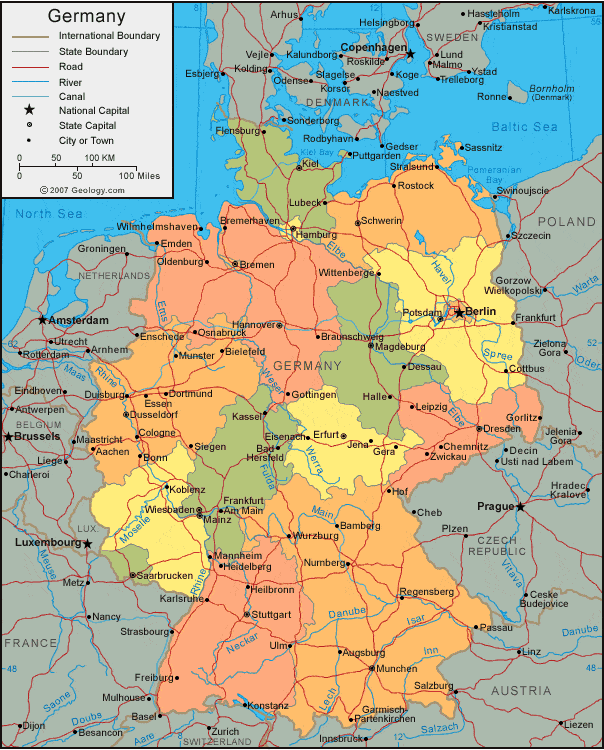
Let the Hardys teach you geography: Shield has a lot of German geography, although I’m not sure it does a good job of pinning the towns and waterways to any context.

The book takes place in southwestern Germany, mainly within the (unmentioned) state of Baden-Württemberg. (For those who have a picture of Germany in their head, that’s down in the lower left of the country, bordering France and Switzerland.) The chums fly into Stuttgart, the capital of Baden-Württemberg and a city of 5.3 million. From there, they take the autobahn south — presumably taking the A81, which runs north and south from the city — passing by the Neckar River; the Neckar is a tributary of the Rhine, running north through Stuttgart until it merges with the Rhine at Mannheim from the East. The narrator contends the Neckar was the border of the Roman Empire at its largest; Wikipedia puts the border a little east of the Neckar, but even if Wikipedia is completely accurate, the assertion is close enough to accept as true.

On the drive, the heroes spot the Black Forest and the Zugspitze. I assume it’s the Zugspitze; the narrator calls it the Zugspitze Mountains, but I believe the author is referring to the peak in the Wetterstein Mountains, which is the highest in Germany (9,718 feet). Perhaps the narrator isn’t thinking of the Zugspitze, though, as it’s in Bavaria’s border from Austria, quite a distance to the east of the Hardys’ path. On the other hand, it’s the highest point in Germany; who knows how far away you can see it?

The Hardys’ destination is Kolbingen. Again, I think it’s Kolbingen; the town’s name is “Köbingen” in the book, but Kolbingen’s location is the right spot, about an hour and a half from Stuttgart. The town’s population is about 1,300. They later attend a winter festival in Esslingen am Neckar, a city of about 92,000 that is less than ten miles from the center of Stuttgart.

Hidden for years, unearthed by the Hardys: Dr. Maxwell is well ahead of the curve in this book, using satellite and aerial images to find the road and fort he’s looking for. Satellite archaeology has become a viable way to search for the past, especially given cheap and free views from space. (Think of Google Earth images, for instance.)

I was surprised to find the Roman emperor Decius, the eponymous emperor, was not made up by this particular Dixon. Decius (or Trajan Decius) ruled from A.D. 249 to 251. Decius was the first emperor to die in battle vs. a foreign enemy, killed in battle (along with his son and co-emperor, Herennius Etruscus) against the Goths in northeastern Bulgaria at the Battle of Abrittus. Evidently that legendary shield Maxwell was searching for was less than effective against, you know, people trying to kill him.

Less convincing is the condition of the artifacts in the fort — “the air is so cool and dry … that everything’s been almost perfectly preserved.” So perfectly preserved, in fact, that Frank and Joe think nothing of picking up swords and daggers from Decius’s treasure trove to defend themselves.

Mid-life crisis at 17: Joe rents a car to get him, his brother, and his brother’s girlfriend around Germany. What does he choose? A red Porsche 911 Turbo, utterly impractical except to stroke Joe’s ego; it barely has enough room for Callie in the back seat, and when they go to a festival with a fourth person, they have to take the train instead. (Frank doesn’t get to drive it often, despite being the person who can read the road signs.) Unfortunately, Joe doesn’t even get a decent car chase. What’s up with that? Don’t Americans always like the car chase?

Duplication of effort: When Dr. Maxwell disappears, certain aerial photos go with him. Joe volunteers to re-acquire the photos from the original photographer. The photographer volunteers to take Joe along with him as he takes the photos again. But why didn’t the photographer keep the negatives? I mean, that’s standard practice, right? For exactly this reason?

Dream big, baby: Stymied for a moment in their investigations, Callie suggests going to the snow festival in Esslingen. Frank tries to avoid having fun with his girlfriend, but eventually gives in: “‘It looks as if Callie gets her wish,’ Frank mumbled.”

Ha! If Callie got her wish, she’d probably have a better boyfriend. The narration does call her Frank’s “girlfriend,” so she’s got that going for her, but the pair only vaguely resembles a dating couple. Sure, Frank gives Callie a kiss on the cheek at one point, but then again, Callie gives Dr. Maxwell’s assistant, Stephi, a farewell kiss on the cheek, so that doesn’t mean much. When Frank and Joe rescue Callie from kidnappers, Frank “clasped her hand briefly.” Such untamed emotion! Callie tries to get a rise out of him while impersonating a wealthy collector, calling him “Honey,” but he doesn’t respond. At least Frank knows not to contradict Callie when reading new year’s fortunes; Callie says her fortune means she will become class president, and Frank keeps his mouth shut, despite his doubts.

Contender for the three most ‘90s’ words ever: “Everyone started moshing.” That’s a complete sentence, written by an adult (presumably), for money. It’s perfect in its ‘90s-ness without being self-consciously ‘90s. Bravo!

The author follows this sentence by saying, a little later, “The band cranked for well over a half hour.” Is “cranked” a synonym for “played” or “thrashed” or whatever that I just wasn’t hip enough to have heard in (*checks copyright date*) goodness, 1997?

We can be heroes: Frank and Joe not only save Dr. Maxwell from being entombed in an archaeological dig but they also save the villain’s unconscious henchmen from the same fate. Impressive, but to add to the degree of difficulty, the two brothers lug the goons out in fireman’s carries up a 15-20 feet tall ladder. I can’t imagine carrying 150 to 200 pounds of dead weight up a makeshift ladder. Well, I can, but my imagination demands I spend 20 minutes before climbing securing the dead weight so I don’t drop it. But Frank and Joe — man, I can criticize them for poor first aid techniques, but they can save lives when they need to.

Opinions: A story set in Germany in winter should be full of local color, but except for the schneefest — snow festival — and new year’s fortunetelling, we don’t see much of Germany beyond the clichés. The schneefest itself is mainly candied almonds and moshing, which isn’t representative of Germany. I don’t think it is, at least.

A foreign culture, the winter cold, youth, exciting new technology: Emperor’s Shield could have been a lot more interesting. Unfortunately, Frank spends most of his time looking over photos and fiddling with his computer, and the detecting is mainly accusations, a harebrained impersonation scheme, and chases. Fortunately, Frank and Joe don’t get to use the local police as their lackeys.

Grade: C-

Thursday, April 14, 2011

Deadly Engagement (Casefiles #90)

Deadly Engagement coverPlot: Fenton’s too busy to look for a missing young man in New York, so Frank and Joe are dispatched to get to the bottom of a Rajesh and Juliet story.

“Borrowing” from the past: Like many stories, Frank and Joe visit New York, and like many other stories, the brothers take an exotic, vibrant foreign culture and distill it into a few curio shops and spicy dishes (including a food allergy). In Deadly Engagement, they combine the two when Frank and Joe spend time in the Little India section of Manhattan; in The Mystery of the Chinese Junk (#39), they visit Chinatown. In The Clue in the Embers (#35), they go to Tony’s deceased uncle’s curio shop in Greenwich Village. (I know, I know; it’s not an ethnic neighborhood; on the other hand, given Tony’s immigrant past, when I remembered Tony’s uncle had a shop in New York, I expected it to be in Little Italy.) Other than those visits (did I miss any?), the boys tend to miss New York’s distinct neighborhoods.

Frank bugs some phones with listening devices designed by Phil Cohen. (Phil doesn’t actually appear in the book, however.) Since the advent of computers, Phil’s been on the forefront of hacking / electronics for Dixons who don’t think Frank should be good enough. In The Mysterious Caravan (#54), Frank says Phil is “good at that sort of thing,” which evidently means sneaking and eavesdropping. The Serpent’s Tooth Mystery (#93) portrays Phil as a “high-tech” genius, an electronic engineering geek. He builds an electronically controlled display case for serpents in that book. His engineering genius nearly gets everybody burned to death in The End of the Trail (#162), when he tries to monkey with an old telephone exchange. In A Game Called Chaos (#160), Phil is a hacker. In Plane Sight (#176) has him as a computer expert.

Adding to the past: Frank and Joe are catsitting for Fenton’s “good friend,” Mr. Scheer. He’s such a good friend that no one has mentioned him in the past, and no one mentions his name in this book either!

Where Is Bayport?: It’s less than two hours to Manhattan by van. No other details are given, though. This would tend to suggest Bayport is on the central to southern end of New Jersey’s coast (around the appropriately named Barnegat, N.J.) or around New Haven, Conn. Unfortunately, this clashes with the description in Beyond the Law (Casefiles #54), which puts Bayport somewhere in New Jersey, not far from New York. Of course, any time you mention where Bayport is in reference to other places, it’s going to contradict another book.

March of Technology: At one point, Frank and Joe call Fenton, trying to find out who a phone number belongs to. Fenton promises to search the NYPD computerized reverse directory, then calls the boys back. Today, there are many Web sites that will allow you to do the same thing — admittedly, the accuracy will be less, but the access is free, and you don’t have to hang up the phone (usually) to get the info.

Convenient: The brothers are spending a week in the Big Apple without female supervision because their girlfriends, Callie and Vanessa, are “still on vacation.” This raises a host of possibilities in my mind. I’m sure we’re supposed to believe both girls are on vacation with their families, but the way Joe phrases it, it sounds as if the girls are on vacation together. Which is possible; high-school friends do go on vacation together. It even happens in the Hardy Boys’ Universe, as seen in Panic on Gull Island, when Iola goes on Spring Break with a friend. I prefer to think, however, that Callie and Vanessa needed a vacation from Frank and Joe; having had enough of their boyfriend’s neglect, suicidal tendencies, and reckless endangerment, each decides they have to get away before they just snap. It’s probably something Callie used to do with Iola before, well, you know.

Laura is annoyed by this lack of female or parental supervision while in New York. At first, she seems merely overprotective, giving the boys reminders and curfews despite the boys being completely able to ignore both. But when she learns they’re going to be investigating while they’re in Manhattan, she sighs “in annoyance.” She just knows some sort of wacky crap is going to happen, and she’s probably going to get a call in the middle of the night asking for money or from some damn emergency room or from the police or a ransom demand or something, and it’s going to ruin the peace and quiet she deserves, dammit.

That’s the way business cards work, Fenton: Although he remembers meeting faux client Biju Kumar at a party, he doesn’t remember giving him a business card — although Kumar says he did. Fenton acts annoyed, although God knows why. You give business cards to people who might hire you, like people who run jewelry stores (targets for robbery, millions of dollars in inventory), but you don’t necessarily have to account for each card. They’re not precious or even coupons, Fenton: you give them out as frequently as is polite or useful.

It’s funny, but only in a coincidence way, not in a punny way: Biju Kumar is a jeweler. His first name is very similar to the English word “bijou”; nowadays, it’s used mainly as the names of movie theaters, when you need an old timey name for a movie theater, but the word means “jewel.”

$10,000 is a lot of money, back now: A shipment of gold jewelry for Kumar’s store is stolen. In today’s terms, that’s not much gold; at the present price of nearly $1,500 per ounce, that would be less than seven Troy ounces of gold. Of course, that’s assuming the jewelry was the nearly pure 24 karat gold but not considering the workmanship that went into the gold. (18K gold is only 75 percent pure, if you’re wondering.) In 1994, when Deadly Engagement came out, that would have been more gold — the average price was below $400 at the time.

He doesn’t love her for her fashion sense: During their investigation, Frank and Joe track down the missing man’s girlfriend, Nikki Shah. He’s described as wearing a “black sleeveless shirt and a yellow miniskirt printed with bright red parrots and was carrying a big, black shoulder bag.” I know it was the ‘90s, and young people in college are going to experiment with personal fashion, but that’s pretty awful. Interestingly, given this interesting color palette to work with, the cover artist chooses to portray Nikki wearing a pink tanktop and dark blue / purple miniskirt.

I despair for you, Joe: You would think, having solved crimes for more than 65 years at this point and encountered different cultures for nearly as long, Joe would be able to do either with some skill. But no, Joe handles witnesses and clients with the aplomb of a man trying to make enemies. At least he keeps his thoughts to himself when he realizes Biju Kumar, his “client,” is “annoying,” but he makes a hash of the rest. He can’t believe two families — the Kumars and Shahs — would allow a feud to last for a century; just because the Hardy family erupted fully formed from the heads of Edward Stratemeyer and Leslie Macfarlane doesn’t mean other families don’t have histories. Joe spooks a potential source by trying to pump him for information about a mysterious local fence with a reputation. And when Nikki talks about her love for Sanjay, Joe blithely suggests Sanjay could have been murdered and that Nikki doesn’t know much more about love than he does. Nikki doesn’t quite realize how she’s been insulted, although she does get it when Joe repeatedly tells her her uncle is likely the one who kidnapped Sanjay. When he actually does it to the man’s face, at least he’s confronting the person he’s accusing.

Of course, Frank has problems of his own: namely, his modesty, or lack of it. When the NYPD detective on the case explains where he got tripped up and the boys didn’t, Frank says “modestly,” “You would have found him eventually.” It’s hard to imagine a more patronizing dismissal from an 18-year-old. Sure, you would have found him eventually. He might have become a drug addict in New Dehli before you found him; he might have been a skeleton who fed the fishes at the bottom of the Hudson River. But I’m sure you would have cracked the case eventually.

Charity begins in the waste bin: Frank throws away aluminum cans in a public trash can, rationalizing someone else could use the money for turning them in. I was more interested in the can redemption than Frank’s trickle-down economics; I had no idea that people had been getting a nickel a can in New York state since 1983.

EMTs to the rescue: Joe discovers he is allergic to cardamom in the usual way, by having an allergic reaction after consuming some. EMTs arrive and give Joe a shot of adrenaline, then leave. That seems a little cursory. Today, the adrenaline is called epinephrine, but victims are generally kept under observation for hours to a whole day because of the possibility of biphasic anaphylaxis — that is, the recurrence of the allergic reaction without exposure to the allergen.

That’s magnanimous of you, Nikki: The climax of the story happens at a block party hosted by Indian Business Association. Nikki reluctantly invites the boys, but given that the party is being advertised on posters all around Little India, I doubt they need your permission to attend, Nikki.

Does he have furry feet?: Like a hobbit, Joe indulges in second breakfast from time to time. In Deadly Engagement, the meal is a very hobbit-appropriate eggs and toast.

Says you, pal: When the NYPD finally gets involved, a detective tells Frank and Joe they “can’t go around questioning people as if [they] were the police.” That’s what you think, buddy — Frank and Joe have made a career of doing it, and they’ve done it over the objections of better cops than you.

Off his game: Nikki joins the boys’ investigation, and Frank leaves Joe and Nikki alone together. Joe isn’t sure he likes that idea, which is weird; usually Joe is all about the ladies. It could be that she has a fiancé, but as he suggested more than once, Sanjay could be dead, and that would technically mean that Nikki is available. And we all know how Frank and Joe feel about technicalities when they benefit the Hardys. It could have something about how he “accidentally” attacked her in the dark and she wouldn’t even accept his hand to help her up, though.

Frank thinks it has something to do with Nikki’s personality: “Joe sometimes had trouble with strong and smart women, and Nikki was both.” I don’t think Frank realizes this, but it makes Joe sound like a date rapist: he has trouble with women whom he can’t physically overpower or trick / bully / cajole into having sex with him. I know that’s not what’s intended, and I don’t even think it’s funny, but it would go along with the stupid, slightly vain, birddogging jock archetype Joe’s later incarnations hew to. Joe does move in for the clinch when he sees Nikki emotionally vulnerable at a friend’s betrayal, putting an arm around her and trying to comfort her.

Emotional responses: After finding out a friend betrayed Sanjay to have a romantic chance with Nikki, she wonders what her response should be: should she be flattered or angry? The answer, of course, is angry — cartoonishly, freakishly enraged that a man thought that all he had to do to win her was remove the man she loved and plotted to send him into exile until he did win her hand in marriage. Yes, angry does it.

Opinions: The most disappointing part of this book is that this particular Dixon takes a colorful immigrant community in New York City and boils it down to jewelry, Curry in a Hurry, arranged marriage, and an old feud. Think of all the details a modern-day Macfarlane would have strewn throughout the narrative; think of the feasts, which would have had no pointless allergies. (Is cardamom that exotic? Wouldn’t Joe have run into it somewhere before?) Religion isn’t even mentioned, despite the Shahs and Kumars coming from part of India near the partition with Pakistan. (OK, religion might be too controversial for the Hardy Boys — but this is the Casefiles! You can blow someone up, surely you can have Hindus and Muslims hating one another without killing each other.) As for the case itself, Frank and Joe fail to zero in on the obvious suspects despite his blinding obviousness. Oh, well — that’s not much different from normal.

Grade: C+. At times I had the feeling Dixon really was trying. Not all the time, of course, but some times.

Thursday, March 24, 2011

The Pacific Conspiracy (Casefiles #78)

The Pacific Conspiracy coverPlot: Skipping ahead to the third book in the Ring of Evil trilogy, Frank and Joe have infiltrated the Assassins, working within a terror cell to discover their evil plan.

“Borrowing” from the past: Not much here. The Hardys have fought a lot of different scary animals, but I have to admit, I’ve never seen a komodo dragon in one of the books before. Kudos, Franklin W. Dixon! Frank is also rescued by the most convenient snake bite ever, as the snake attacks the Assassin who is about to inform his superiors about Frank’s true identity. The snake isn’t identified — it has black and gray stripes — but it kills quickly. (Sort of like the Vietnamese Two-Step Viper, except quicker.)

Real places: The Assassins try to detonate their world-altering nuclear bomb — a real Bond-villain plot — on Mount Agung. Mt. Agung is a real volcano on the Indonesian island of Bali; it last erupted in the early ‘60s. The Mother Temple of Besakih, a Hindu temple, is located on the slopes of the mountain.

That’s one way to put it: The narration says, on page 2, that the Hardys have infiltrated the Assassin cell through a “remarkable series of events.” Although the narration eventually fills in readers, such as me, who skipped the second book, I think I would have left it at that — actually explaining things doesn’t help at all. I prefer to take it on faith that I would find the explanation preposterous rather than to find out that I’m right.

One of the more idiotic aspects of this infiltration is that Frank and Joe don’t even bother to come up with aliases. Now, Frank and Joe have clashed with the Assassins before; in the first book, Dead on Target, the Assassins were even hired to kill Frank and Joe. Not all Assassin operatives will likely have heard of that utter failure, but you have to imagine that Frank and Joe are fairly well known in certain circles. It’s eventually revealed that the Assassins are playing with Frank and Joe — that they’ve known the entire time that Hardy boys are, in fact, the Hardy Boys — but it doesn’t make Frank and Joe (or the Network) seem any smarter.

Using their superpower of stupidity: Even beyond the idiocy of using their real names, I have, in my notes, many notations of Frank and Joe’s (mostly Joe’s) stupidity. When Joe is pursuing one of the Assassins on Mt. Agung, the Assassin invites him to come, unarmed, to fight him at the top of a ladder. Of course, the assassin waits and stomps on Joe’s hands when he gets to the top. When Joe’s not-girlfriend Gina reappears, miraculously alive, in the middle of an armed standoff in an Assassin camp despite being “killed” in the previous book by Assassins, Joe allows her to disarm him easily before he can get suspicious. Frank knocks a gun away from an Assassin and suddenly thinks he’s evenly matched with the man; the Assassin immediately begins kicking his butt until Frank’s final punch wins the fight.

Perhaps with Joe this is a priority of brainpower. When he’s pulled out of a canal with concrete boots, his first comment (on the escape of the Assassin who put his feet in concrete and tossed him in the canal) is, “Good riddance. The guy was nothing but dead weight anyway.” Not a great pun, but it is impressive when you consider how close to death Joe had just been.

Hail Mary bomb: Young supergenius (and nuclear bomb builder) Dr. Krinski is photographed in a Dallas Cowboys sweatshirt with the #12 on it. That’s probably a reference to quarterback Roger Staubach, who retired in 1979. However, since the Cowboys don’t retire numbers, it could refer to other, lesser players who have taken that number since.

The March of Technology: When Krinski says he needs to check some calculations for his project, Frank volunteers to help. When Krinski asks for his qualifications, Frank mentions some computer programs he’s worked with. Just out of curiosity, what programs, commercially available in 1993, would Frank have used and be useful for modeling dropping a nuclear bomb through lava or constructing a nuclear bomb? Perhaps more pressingly, why the hell would Frank have used them? Modeling the trajectories of bullets, perhaps? Or pieces of shrapnel? Other than extreme crime scene recreation, I have no idea.

Your case. Really: When the Network and the Gray Man sensibly try to send the Hardys home, Joe complains it’s their case. Never mind that competent agents don’t need a couple of teenagers mucking up their search for a nuclear bomb; it’s Frank and Joe’s case! And because it’s their book as well, they manage to slip their minders and return to the investigation. When they manage to pick up the trail of an Assassin agent, Frank declines to call the Network so they can investigate on their own. Hey, what’s a little nuclear annihilation compared to the glory of the Hardy Boys?

Do you really want an answer to that question?: When Frank and Joe find a dead body, a Network agent asks them, “You didn’t move the body, did you?” Joe indignantly responds, “What do you think we are? Amateurs?” Depends on the mystery, Joe — you usually do protest that you’re amateur detectives.

One MILLION dollars: When the Assassins threaten the world with their world-altering nuclear bombs, they make their ransom demands to the United Nations General Assembly. Because, yes, when you want quick action and results, the organization you go to is the UN General Assembly. They may have had better results by submitting their demands to the Girl Scout National Board of Directors — that cookie money does add up, I imagine.

There’s no racism like subtle racism: The Balinese lad who helps the Hardys (and saves the world by informing on them to the police) is named Haji. That sounds worse today than it did in 1993, given that “Hadji” is a derogatory term used for Iraqis by American soldiers during the Iraq War.

False dichotomy: When Frank is following Joe and Network agent Endang up Agung, he finds the motorbike they were riding. His immediate thought is either the pair were captured or killed. He fails to consider they may have abandoned the bike for noise or mechanical reasons or a dozen other reasons. And remember, Frank’s the smart one.

My girlfriend’s back: At the end of Pacific Conspiracy, Vanessa Bender wanders up to the Hardy home. I had no idea Joe was dating Vanessa at this point; I thought she was introduced later in the series. Joe’s behavior toward Gina and Endang gave me no indication he was going out with anyone.

Vanessa’s entrance line is, “Glad to see me?” Joe answers, “You bet.” I was almost waiting for him to ask, “You won’t blow up on me or get shot or get shot again, will you?” I like to imagine two different responses from Vanessa:

a) “No, I’ll be fine, but if I hear about you flirting with or kissing another girl again, even to save your life, I swear to God you’ll be dead.”

b) “I promise I won’t die. But some day the Casefiles are going to end, Joe, and then what will happen to me? It won’t be death, but I won’t even have generated the nostalgia that will bring Iola back to life, even in a limited capacity. In a way, that’s even worse — a kind of a half existence, not quite here but not quite gone either. Is that what you want for me, Joe?”

I find the former more realistic, but I’m affected more by the latter. I never completely adjusted to Vanessa, but I always found her role interesting in a sad sort of way — she’ll never be Iola, to Joe or the readers, and she’ll never get a chance to be anyone else. In this sense, Assassin cell leader Nwali has Joe pegged: “I do envy your skills with the ladies, Joseph. One girlfriend dies, and you find another.”

Opinions: The Pacific Conspiracy, I suppose, is like a Casefile forcibly mated with one of those late Grosset & Dunlap books, a world-trotting adventure where the world just could coincidentally end up getting exploded by a nuclear bomb. The too easily beaten Assassins and their Bond-villain antics are tiresome and predictable, and although I appreciate that the Assassins were more sadistically overconfident than incompetent, they should have known Frank and Joe’s success level and just poisoned them. I also believe Nwali should have had a better quirk than a fondness for Indonesian puppet theater, though I give a tip of the hat to Dr. Krinski having a komodo dragon for a pet. Again, kudos, Franklin W. Dixon!

It did amuse me, however, when Frank creates a panic using rubber monkey-fighting snakes to escape from a Monday-to-Friday plane. Samuel L. Jackson would be proud!

Grade: C-. I do envy your skills, Joe.

Thursday, March 17, 2011

Tagged for Terror (Casefiles #76)

Tagged for Terror coverPlot: Frank and Joe head to Atlanta to find out why luggage is being stolen from Eddings Air flights.

“Borrowing” from the past: Fake jobs! The Hardys have a long and distinguished history of getting jobs for a week or less so they can investigate some sort of skullduggery. This must leave them with the most checkered resumes in the history of Western employment, but it does get results. In Tagged for Terror, the first book in the “Ring of Evil” trilogy, Frank and Joe work as baggage handlers for Eddings Air. To solve cases, Frank and Joe have also worked:

  • As sailors on the Black Parrot (The Twisted Claw, #18)
  • As a snake tender (Joe) and elephant feeder (Frank) in “Big Top” Hinchman’s circus (The Clue of the Broken Blade, #21)
  • In a Hay River restaurant (The Viking Symbol Mystery< #42)
  • In construction jobs on a Kentucky road project for Prito Construction (The Mystery of the Spiral Bridge , #45)
  • For a builder, learning the signs that a building is unsafe (The Crimson Flame, #77)
  • Moving scenery on a movie set (Cave In!, #78)
  • As Dandy Duck (Joe) and Piggy Bank (Frank) at Fantasieland (Sky Sabotage, #79)
  • As lumberjacks for the Peapack Lumber Company (The Demon’s Den, #82)
In addition, the boys washed dishes in return for a restaurant breakfast (What Happened at Midnight, #10), helped explore an underwater wreck and raised a sunken ship for Crux Salvage (The Secret Warning, #17), washed cars at the Highway Garage in Brockton (A Figure in Hiding, #16), worked as cowboys at the McVay Ranch (The Crimson Flame), were stationed in the Underwater and Grasses and Lillies sections of the State Experimental Farm (The Flickering Torch Mystery, #22), did chores for the Millwood Art School (The Haunted Fort, #44), and unloaded bricks for Prito Construction (The Outlaw’s Silver, #67).

Although he doesn’t step in behind the yoke, Frank mentions that he’s done some flying. His flying experience is chronicled in my post on Power Play (Casefiles #50).

Whee!: That is one boring cover — possibly the most boring of any book I’ve covered on this blog. There’s no danger, nothing interesting going on at all. It’s just Frank and Joe doing their fake job at Eddings Air. Not even Joe can convince himself it’s fun, even though he’s hanging off the side of the cart, getting ready to sidehack.

With Hank Forrester as “Ezra Collig”: The head of security for Eddings Air, Hank Forrester, is described as “a beefy, red-faced man in his fifties, with thinning salt and pepper hair.” He’s constantly denigrating Frank and Joe’s abilities and stealing their thunder. He reminds me of someone in these books, but I can’t remember who …

File under “good question”: Forrester may be a jerk, but he does have an interesting question: when Frank and Joe stand in as Fenton’s surrogates in investigating the missing baggage from the flights, he asks, “Private investigators? Where’s your license?” Usually, when they’re poking around on their own, it’s just a couple of kids being nosy — Encyclopedia Brown with higher stakes and a more literate audience. But on this case, they’re acting as Fenton’s surrogates, and presumably, neither Fenton’s time nor the boys’ is free.

There are all sorts of legal and liability issues to consider here; I mean, this isn’t the ‘60s, when you can send boys all over the country with minimal or no supervision. Life is more litigious and allegedly more dangerous (although I suspect the same number of childhood tragedies happened in each era, and today’s get more publicity). Back in the ‘60s and even the ‘70s, we could pretend that those sort of concerns didn’t matter. And we still can. But when a character points this out, it becomes a problem, and it would have been even when Tagged for Terror came out in 1993.

Ladies’ man: When the first pretty girl comes along, Joe starts flirting with her. That’s presumably why Iola was killed off at the beginning of the Casefiles series: to give Joe a chance to hit on whatever attractive girls the mystery brings along without guilt. He frequently did that anyway, late in the Grosset & Dunlap days, but no one ever thought it was strange he had a girlfriend and would flirt anyway — sometimes even in front of Chet, Iola’s brother. In this case, it’s Gina Abend, a ticket agent for Eddings. What’s strange is, she responds, despite a) having a boyfriend, and b) not being in high school. Looks like someone wants to rock the cradle of love. Frank tries to shut Gina out, but not even memories of Iola can keep Joe from following his heart (or other part of his anatomy).

To you kids all across the land, there’s no need to argue: adults just don’t understand: Forrester is always ragging on Frank and Joe’s investigation, and Eddings and his pilot, Solomon Mapes, treat them like kids. This the way the books should be: adults are, generally speaking, not all that bright or observant. It’s the way life feels when you’re in high school (and when you’re in grade school or junior high, for that matter); it should be reflected in the books, especially when the Hardys are on the road.

God help him, he’s not very bright: While talking to Gina and Solomon (her boyfriend), Joe muses about the case, thinking an earlier airplane accident might have been intended to kill him and Frank rather than Eddings. Frank covers for him, but Joe really needs to learn to have an inner monologue.

Play to your strengths: It’s a running joke in the Casefiles: when Frank has a plan, Joe complains that Frank’s plans involve him doing something stupid. I’m not sure that’s actually the case, but I have to say, Joe is portrayed as being a little dull-witted, so at least those who have been watching the boys will feel the stupidity is in character.

Later in the book, Joe sarcastically suggests Frank’s plan will involve him dressing “up like a girl and [having] me bat my eyelashes at him until he tells me his deepest secrets.” This is the kind of plan Bugs Bunny devises, so I think we have an idea what Joe’s doing when Frank’s studying.

Mr. Architectural Snob: When Frank and Joe head to an area of Atlanta that’s a little run down, Joe notes the size of the houses; Frank immediately wonders how long it will be before the houses are knocked down (or fall down), just because the porch sags a little and the paint is faded and chipping. Not every place can be High and Elm, Frank. Geez.

Atlanta, still reeling from being burned to the ground during the Civil War: After Frank and Joe are ran off the road and one of their tires shot by a drive-by gunman, the boys tell their new acquaintances — “friends” would be too strong a word — about the incident. The big-city residents are blasé about attempted vehicular homicide and random gunplay on city streets during broad daylight, calling it “big city problems.” I don’t think I want to hang around with people who don’t at least say, “Sorry to hear that,” when they hear you’ve been shot at.

The March of Technology: Danny, an impoverished student who works at Eddings Air to put himself through college, uses an old manual typewriter, which shows how poor he is. Today, what would the equivalent be — a broken-down laptop? Going to the computer lab to do homework? An old IBM? I don’t know.

Also, for some reason, Frank and Joe don’t have their cell phone with them in Atlanta. Avoiding roaming charges, perhaps? In any event, when they have to call the police at the end of the book, one of them actually has to knock on a neighbor’s door and ask to use his phone.

Sorry, Mr. Hick, sir: Frank wakes Joe up at 4 a.m. before traveling two hours to Danny’s small hometown, his explanation being that people get up early in the country. Well, yes, some do, especially farmers, but those that work in offices (and some factories) won’t be up until later. And even the farmers won’t appreciate being interrupted at 6 a.m. by a pair of smart-assed kids.

And of course, rather than waiting until they’re off work and can visit these poor rural dwellers at a reasonable time, Frank and Joe skip work. That is, they don’t report to the work they need to keep to investigate the luggage thefts. They run the very real risk of getting fired, and no one who knows their mission could interfere without revealing their undercover mission.

Matters of the heart: At one point, Frank remembers his girlfriend, Callie, often helps them investigate crime. He also thinks he “often told Callie things that he would never tell anybody else.” What on earth would that be? What would he tell Callie that he would not tell his father or Joe? Frank and Joe are close, as close as any two human beings can be. Does Frank confess his secret insecurities to Callie? Does he tell her that he can’t maintain the constant investigations, that he will crack sooner or later?

Or does he tell her that he’s creeped out by Chet’s constant eating (suggesting a betting pool for his first heart attack?), or that Aunt Gertrude’s food really tastes like old person and disapproval?

We don’t need no stinkin’ proof: Near the end of the book, Joe doesn’t want to confront a suspect because they have no proof that he’s done something wrong. Constrast this to Joe’s behavior in Open Season (Casefiles #59), when he will accuse anyone of anything at any time.

Opinions: The Network and the Assassins are the Casefiles overlying storyline, and their appearance in Tagged for Terror is what gives the book the impetus to be the start of a trilogy. I admit, I’ve never warmed to Network vs. Assassins or the Hardys’ Network contact, the Grey Man; it seemed like it was stretching the suspension of disbelief much too far. Much of the Hardys’ adventures can’t stand too close examination, and really, the Hardys investigating superspies vs. contract killers can’t even be mentioned before snapping my belief. The later Casefiles moved away from this, and I appreciate it; I preferred the Casefiles to be the mysteries where the Hardys can investigate murders.

I was surprised by the sudden switch to the Casefiles mythology. Tagged for Terror starts as a normal investigation into a theft ring. And because it’s a Casefile, the bodies start to pile up. (I have to admit, it’s strange that getting shot at and forced off the road does not distinguish the grittier Casefiles from the more reserved canon and digests.) And in that light, it’s a pretty standard mystery, perhaps a little above average. But then the Grey Man shows up, and the Assassins are mentioned, and the Network has an interest … but Frank and Joe still do all the work. Is the Network what Reagan was thinking about when he complained about the inefficiency of government?

Grade: B-. I am amused by Joe’s plucky pick-up attempts.

Thursday, March 3, 2011

Beyond the Law (Casefiles #55)

Beyond the Law coverPlot: Ezra Collig is accused of corruption from his time in Millerton, a quarter of a century before. When the Hardys and others investigate, the police commissioner and a TV reporter are nearly blown up.

“Borrowing” from the past: Beyond the Law really takes the time to fill in Ezra Collig’s past in a way that hadn't been done before. In the original canon, Collig’s life was a blank slate; he’s an old acquaintance and occasionally friend of the Hardys who professionally serves as anything from a hindrance to a lackey. Other than being afraid of bad publicity, being in his late 40s, and gaining the office of chief of police fewer than five years before, Collig has done little but sell Frank and Joe the supervan they use in the Casefiles and Digests. But Beyond the Law fills in the gaps. He dropped out of school to earn some money, joined a road construction crew, then made it onto the Millerton Police Department. After a brief term of service — he quit after exposing his partner’s graft — he returned to high school in Atlantic Heights, married his teacher Bea Cowan after graduation, and then joined the force in Bayport, rising all the way to the top. Bea passed away shortly before the beginning of Beyond the Law.

Collig also reminisces about how the increasing awareness of the legal rights of criminals has put a crimp in crimefighting. It’s amusing to hear Collig talk about how gunning a man down used to get you medals and a promotion but now gets you fired or that whacking suspected thieves on the calves was just prudent; it’s somewhat worrying to hear Collig complain about having to have sufficient cause to search a suspect, what with the Constitution and whatnot. Although on one hand this is a reminder that the past is a foreign country — they do things differently there — it’s also a reminder that the Hardy Boys canon, while ostensibly less violent than the Casefiles, had a lot of dodgy rights stuff going on within them that had nothing to do with racism. It’s also clear that the Hardy Boys can ignore the constitutional rights thing, as long as they don’t kill people or whack them in the calves.

Joe repairs the van, adjusting its timing. Joe has done a lot of mechanical work over the years, repairing the roadster and his motorcycle with his brother in While the Clock Ticked (#11), souping up a dirt bike in The Mystery of the Samurai Sword (#60), and tuning up the car in The Billion Dollar Ransom (#73). In A Figure in Hiding (#16), it’s said he liked “nothing more than a mechanical problem”; in The Crimson Flame (#77), the narration mentions he and his brother often work on their car.

Fenton’s sartorial advice for the mystery: “Wear a good suit, and you’re bound to get mud, crud, or blood on it. Only cops who stay in offices can dress up for the job.” For more of his pearls of wisdom, see Last Laugh (Casefiles #42).

Frank and Joe give mouth-to-mouth resuscitation. The boys have always been good at first aid, and both have given mouth to mouth before: Joe in The Secret of Pirate’s Hill (#36) and The Viking Symbol Mystery (#42), Frank in The Clue in the Embers (#35), The Mystery of the Spiral Bridge (#45), and The Arctic Patrol Mystery (#48). Probably the most challenging first-aid work that either has ever done was in The Mystery of the Flying Express (#20), during which Frank attended the victims of a train derailment.

Where is Bayport?: After Frank and Joe have a few sticks of dynamite lobbed at them while on the interstate on their way back to Bayport, Joe asks, “Hey, you’re not going to try to catch the Mad Bomber of Route I-forty-nine, are you?” Although I don’t know what Route I-49 could mean other than Interstate 49, Bayport is nowhere near that road. I-49 runs between I-10 in Lafayette and I-20 in Shreveport, entirely within the state of Louisiana.

When Joe looks for Millerton on the map, he notes that it’s as far away from Bayport as one can get and still stay in the same state. Later, when the boys head to Millerton, the narration says it took a couple of hours. That leaves New York and Connecticut out of the running for Bayport (at least for this book); from New York City to Buffalo is more than six hours, and nothing in Connecticut is even close to being two hours from anything else in Connecticut (traffic permitting). But two hours works out about right for New Jersey; both the southeast and southwest corners of the state are about two and a half hours from the New Jersey part of the New York metropolitan area. If you move away from New York, say to Long Branch, Keansburg, or Asbury Park, the time works out about right.

Idiot’s Affairs: Obviously, when the scandal about what Collig might have done in Millerton comes out, the publicity conscious Bayport PD kicks him to the curb and starts their own Internal Affairs investigation. Why they do this is beyond me; the allegations were more than a quarter century earlier, and it has nothing to do with Bayport. (The Millerton PD seems uninterested in the allegations.) The IA detectives turn up nothing, of course; it takes two motivated teenagers to get something done. Like notice that a bunch of cops quit at about the same time as Collig. Frank and Joe don’t actually talk to any of these cops, but hey, they took the first step.

The new top of the police bureaucracy is portrayed as the villains in this book, but it’s hard to dispute two of their points: Kid vigilantes have no business in modern crime control, and if the entire city government was corrupt, it’s a reasonable assumption that Collig or someone on his force was also corrupt. Of course the investigation is shoddy and wrongheaded, but they at least started from the right point.

The March of Technology: While using the Millerton Police Department’s equipment, Frank finds their link to state databases is a “nearly obsolete computer.” I (barely) remember computers in 1991, and I’m having trouble figuring out what could be both nearly obsolete in 1991 and could still uplink with the state servers. A TRS-80? An Apple II?

When Frank and Joe announce on live radio they are going to Millerton to investigate the allegations against Collig, nearly everyone seems to hear the news. In a town with its own TV station, would everyone really be listening to the radio for an update on the Collig “corruption” case?

When Frank and Joe go with Callie to visit her friend Liz at the Bayport Times, they find her working on a typewriter. When I worked at newspapers, a half decade later at newspapers not much bigger than the Times, no one used typewriters — everything was computerized, although sometimes clunkily. But in 1991 … is Liz’s typewriter an anachronism, or is it a possibility? I don’t know.

I’ll take Forced Metaphors for $400, Alex: In a bit of deathless prose, Frank muses, “They’ll figure Collig left Millerton under a cloud … I just hope that cloud doesn’t rain on the chief’s parade.”

The Eagle: According to Beyond the Law, Bayport’s TV station is WBPT. There is, of course, no television station with that call sign; however, since 2001 it has been the call sign of a radio station in central Alabama: 106.9, the Eagle — “Birmingham’s home for classic hits.” When Beyond the Law came out, the station was WBMH, a country station. That iteration lasted about a year.

Modesty will get you nowhere: Frank mentally complains about the media always using the phrase “famous private detective” to describe Fenton. I know it must get monotonous — Fenton might as well change his name to Famous Private Detective Fenton Hardy, FPDF Hardy for short — but he is a famous private detective. Again, Frank and Joe have been using his name across the country as a get-out-of-logic-free card for years.

Separation of Frank and Joe, Part II: Like in Panic on Gull Island, Joe has a friend independent of Frank. Unlike in Gull Island, this cryptozoological specimen has a name: Johnny Berridge, a cameraman at WBPT. Berridge is obviously not a chum, which means he’s a … a … (I can hardly bear to say it) … a source.

In the old days, of course, the Hardys didn’t have sources — at least not consistent ones. They would come to town, pump you dry of information, and go about their business, never to see you again. If you were lucky, you might get to be a chum for a book, serving as extra manpower or as a sort of guide. But a consistent source? That suggests the Hardys have some sort of plan about their sleuthing, and that’s just un-Hardylike. On the other hand, it probably fits the Casefiles better.

Taking the wrong notes from Collig: After replacing Collig, acting chief Parker Lawrence tells Frank and Joe they are “finished on this case”; like Collig in Power Play (Casefiles #50), he forgets Frank and Joe have no real standing to be on the case, so there isn’t really a “case” where they are concerned, and they don’t work for him, so it’s not like he has the power to order them off the case. Threaten them with arrest, yes; order them like a boss, no.

Yee-haw!: This Dixon notes Joe uses the high beams on the way to the Morton farm. This is not noteworthy. If you live on or travel to a farm at night, chances are you will frequently get to use the high beams.

Don’t give Joe any ideas: After Collig tells Frank and Joe that (in a non-creepy way) he married his high school teacher, Joe muses that it’s “one way to get good grades.” Joe, I know you’re single, what with Iola being reduced to particles, and the book learnin’ is sometimes a challenge, but there are laws against that sort of thing. I know you don’t care about laws when they apply to you, but they’re there for your protection. Trust me. The short-term gain isn’t worth it.

Now, your brother — he’s 18. He can do what he wants.

Opinions: This is the book that should have been #50 for the Casefiles. It uses the series’ continuity, referring to Frank and Joe’s work in See No Evil (Casefiles #8) as the impetus for the anti-corruption drive that ends up with the reform candidates seeking to drive out Collig. It also features Collig, a long-time supporting character. It’s also nice to see Ezra Collig’s backstory get fleshed out, although a random Casefile is an odd place for that to happen.

As for the mystery itself … Well, it’s better than Power Play, but that’s not saying very much. The reform party’s attempts to dig up dirt on Collig are feeble — actually, calling it feeble is an insult to all the feeble people out there, especially the feeble minded. Forget the technology of the computer, which Frank understands but the Internal Affairs cops do not; they don’t quite get the combination of telephones and personnel records. Or, when it comes down to it, talking, something Frank and Joe mastered quickly. Frank and Joe even found the right guy to talk to immediately.

Also: Tossing dynamite at the Hardys while both are driving down the interstate. I can’t tell if that’s completely mental or completely awesome, but either way, it has no part in a Hardy Boys book, and it’s quite telling that Frank and Joe drive away from the bombing as quickly as possible so that they don’t get caught up in the mentalness / awesomeness or the justice.

Grade: C. When you balance the highs and the lows, it’s completely average.

Thursday, February 24, 2011

Power Play (Casefiles #50)

Power Play coverPlot: Frank and Joe are hired to check the security at Bright Futures, a company that makes solar cells. However, before their investigation can get underway, one of the company’s top researchers is murdered.

“Borrowing” from the past: In Power Play, Frank mentions he recently got his pilot’s license, certifying him for single-engine planes. Frank first flew a plane (under supervision) in The Mystery of the Flying Express (#19). In The Short-Wave Mystery (#24), both he and Joe get instruction from a pilot named Stewart, but Jack Wayne — Fenton’s personal pilot — doesn’t start teaching them until The Ghost at Skeleton Rock (#37). He even makes an emergency landing in that book. He and Joe get their license in The Mystery of the Chinese Junk (#39). By The Viking Symbol Mystery (#42), he can perform loops, banks, and rolls in a seaplane, and he passes the FAA proficiency test for float planes. In The Arctic Patrol Mystery (#48), he lands a twin-engine plane … on a glacier. The Stone Idol (#65) mentions he has flown helicopters at the Bayport air field; in The Blackwing Puzzle (#82), he and Joe build an ultralight with their friends.

That last is important, because in Power Play, Frank rides in and briefly flies a solar-powered ultralight plane. Now, I kept track of how the Hardys get around, but I don’t think they’ve ever used a solar-powered ultralight plane. In The Blackwing Puzzle, they do fly an ultralight called the “Silver Falcon,” but it wasn’t solar powered. In fact, I don’t think they ever traveled in something solar powered in the first 85 books. (There was an electric car in The Skyfire Puzzle, #85, but that doesn’t count.) That’s surprising, since the Hardys have flown in hot-air balloons and a space shuttle, used parachutes, skimmed across the bay in ice boats, swum powered by porpoises, trekked with mules, even used a hand car. But never a solar-powered ultralight.

Frank and Joe get extra time to investigate because of Spring Break. I expected the boys to have experienced Spring Break about forty times before the Casefiles, but during the canon, they used it to get out of school only three times: The Arctic Patrol Mystery, The Firebird Rocket (#57), and The Voodoo Plot (#72). They also used Spring Break to track down Iola in Panic on Gull Island (#107).

The March of Technology: Oh, 1991. Computers were so exciting then — even interoffice electronic mail (“e-mail” not being a common enough usage) and 300 megabyte optical “disks” (the ones I have sitting by my desk, made for CDs, hold 700 MB) are breathlessly reported as exciting advances … even though you had to have a special drive for the 8-track like optical disks. Some technological plot points are relevant, however; the murdered researcher smuggled sensitive information out of Bright Futures by switching the label from a rock CD to the optical disk. This is similar to how Private Bradley Manning smuggled sensitive information off a secure Army intelligence server in Baghdad to give to Wikileaks; he brought in a CD-RW labeled “Lady Gaga,” erased the music, then copied the information onto the now empty disc. (I’m still not sure how the researcher switched the label, however; were the labels on early CDs stickers?)

Frank and Joe have a cellular phone (again, “cell phone” is not in common enough usage in 1991), but when they try to use it, there’s too much static. Their provider must be AT&T. Zing!

You’re slipping, old man: Fenton … I worry about the old man. In Power Play, all those concussions seem to be catching up with him. In the beginning, when a client calls him a “famous detective,” he says, “I don’t know about the ‘famous’ part.” That could be him being humble, but I don’t think you can be humble about your reputation when your sons use your name as a “Get out of jail free” card from coast to coast.

Later in the book, Fenton tells his sons that a researcher for Bright Futures has been arrested. Two pages later, he says, “[The researcher] could be home by now — if she has a good lawyer. She doesn’t have an arrest record, and there’s probably not enough evidence to charge her.” Not enough evidence to charge her? She’s already been arrested! That means she’s been charged! Do you even listen to yourself, Fenton?

Halfway through the book, Fenton goes jogging in a mesh shirt. Putting aside how smart I think jogging is, I keep getting an image of Fenton in an open-mesh shirt that is pretty much see-through (been watching too much anime, I guess). That’s not a pretty picture. In any event, in this picture of parental authority, he tells his sons that he wants to pull them off the murder investigation because they were only hired to investigate security, and murders are dangerous. Neither of these considerations have either bothered Fenton before; I don’t know if this is how Fenton is portrayed in the Casefiles, but it does fit in with the worrywart who founded ATAC in the Undercover Brothers series.

Speaking of slipping: Frank and Joe suffer the indignity of the “cut-the-brakes” trick. Frank later says it wasn’t a murder attempt; they shouldn’t have made it out of the parking lot. That seems an awful chance to take; I think, under New York law — as given unto us by DA Jack McCoy on Law & Order — that it shows a reckless indifference to the boys’ life and therefore would be classified as attempted murder, but what do I know?

In any event, Joe, who is driving, tries to use the parking brake to slow the van first. Only after that does he downshift. He should have tried it in the other order, which would have been more effective.

Speaking of ‘off the case’: At one point, Chief Collig — who has been antagonistic to Frank and Joe the entire book — tells them, “You’re off the case.” Firstly, he has no real authority over them, except when they break the law. (Which admittedly is all the time in this book, so perhaps I’m selling him short.) Secondly, a “case” suggests an official investigation of some sort, but Frank and Joe have no official standing — not even a private investigator’s license. For the Hardy Boys, there’s no case for them to be on. In fact, by telling them they are off the case, Collig implies they were either on the case before or had some sort claim to be on the case. I think Ezra just wanted to say those words to a couple of loose cannons, and whether the words made sense be damned.

Asking for trouble: Weirdly, Bright Futures hires Fenton’s sons just to check security. That is, the company had no idea there were no problems before Frank and Joe came along. Of course, afterwards, there’s a murder, the company is revealed to be rife with industrial sabotage, and the company’s remaining researcher is poached by a competitor. Nice job, boys.

The new math: After the head of Bright Futures tells Frank and Joe about a dispute between his top researchers — one of whom is now dead — Frank “filed this information with what they already knew. According to his math, none of this added up to murder yet.” I would really like to see what that equation looked like: Motive + death ≠ murder?

So there’s a … “Superb Bowl”?: God knows I am not a big fan of American football. I prefer baseball by far, and I agree with George Will’s contention that football combines the two worst aspects of modern American society: violence and committee meetings. But dammit, why can’t Dixons ever get the game quite right?

In The Crisscross Shadow, Chet is listed as a center, which is an offensive position, but he’s shown only as a defensive player. Even if there is a defensive center — and there isn’t really, although perhaps a defensive tackle in on a three-man line could be considered a “center” because he’s between two other players — he wouldn’t cover receivers on pass plays, as Chet tries and fails to do. (Maybe he’s a middle linebacker, which would fit the criteria.) Joe is said to be a left halfback — “halfback” is usually as specific as it gets — but he throws all the passes for Bayport, which is the quarterback’s job. Frank’s supposed to be the quarterback, but he functions as a receiver. At one point, the teams are locked in a defensive duel which forces each side to run two plays, then punt; each side gets three plays before they need to decide whether to punt. I’ve already gone over the ludicrousness of everything in Foul Play, which had no clue about football.

In Power Play, the offense is much lesser: Chet is said to have the “wide, massive frame of a football linebacker.” There are many other positions that could be better said to have a “wide, massive” frame; offensive or defensive linemen are prime candidates. Linebackers are large but have to be more athletic than linemen since they not only have to overpower people but also cover receivers. In fact, if you want a stereotypical description of linebackers, it would be quick and powerful rather than wide and massive.

It’s a small detail. But it’s a small detail about the most popular sport in America. Is it that hard to get right?

Opinions: Frank and Joe are at the nadir of their investigative abilities in Power Play, with Frank and Joe’s investigative techniques alternating between random accusations and breaking and entering, with a bit of bullying Chet thrown in to keep things from getting too predictable. They antagonize all the authority figures they can find, and Chief Collig and Fenton decide to finally draw a line and rein in the boys for reasons I can’t quite discern. Child endangerment laws catching up with Fenton and Bayport, maybe? Perhaps other municipalities giving Collig hell for using teenagers to solve his crimes? I don’t know, but neither Collig nor Fenton seems to want Frank and Joe on the case despite their results and their ability to avoid death.

I also find it odd that the Casefiles would hit their fiftieth book and not do some sort of anniversary stunt. Then again, the series was less than five years old at the time, so perhaps it was considered too early to do something like that.

And as I mentioned before, I really don’t like the cover. That it superficially resembles something that happened in the book is irrelevant.

Grade: D. Not very good. The optimistic “unlimited promise of solar power” angle and technology dates it more than perpetual teenagers Frank and Joe ever could.

Thursday, February 17, 2011

The Last Laugh (Casefiles #42)

The Last Laugh coverPlot: Frank, Joe, and Chet investigate kidnappings, bombings, and arson at a comic book convention in San Diego.

“Borrowing” from the past: Casefiles don’t care much about the past, but there are some links to the proud Hardy Boys traditions. Or maybe the Casefiles duplicate earlier books without knowing any better.

In this case, the background details are somewhat similar to The Apeman’s Secret (#62). In that book, Frank, Joe, and Chet are all interested in comics (although Chet more so than the Hardys), and they are called to investigate crimes committed by people dressed up as comic book characters, just as they are in Last Laugh. Chet even gets a story published by publisher Star Comix (Marvel Comics actually started a kids-oriented imprint called Star Comics in 1984). Chet even dresses up as a villain for a comic-book costume party. (The party wasn’t at a convention, though; it was at the Alfresco Disco. Ah, 1980.)

Joe remembers some of Fenton’s advice early in The Last Laugh: no clue is too small for a good detective. Other gems from Fenton include:

  • “Listen much and say little.” (Hunting for Hidden Gold, #5)
  • “One of the first requirements of a good detective is to keep his ears open and his mouth shut, and to be wary of confiding in strangers.” (What Happened at Midnight, #10)
  • “A good detective doesn't let his impulses get the better of him.” (The Disappearing Floor, #19)
  • It is an admission of defeat to call the police. (The Flickering Torch Mystery, #22)
  • There is “no more dangerous or cruel fighter than a cornered criminal.” (The Secret Panel, #25)
  • Note the time of any unusual occurrence. (The Secret Panel)
  • “A good detective must be observant of small details.” (The Phantom Freighter, #26)
  • “Never discard a single clue.” (The Secret of the Lost Tunnel, #29)
  • A little undercover sleuthing in advance is better than barging in head on. (The Crisscross Shadow, #32)
  • Do not talk to strangers about cases. (The Ghost at Skeleton Rock, #37)
  • Safeguard any valuables you come across during a case. (The Mystery at Devil’s Paw , #38)
  • Two of a “detective's best friends are the newspaper and the police.” (Mystery of the Desert Giant, #40)
  • “In detective work, sometimes it's the crazy clues that bring results.” (Mystery of the Desert Giant)
  • The modus operandi is often the best way to identify who committed a crime. (The Night of the Werewolf , #59)
  • Do not take foolish chances. (The Night of the Werewolf , #59)
  • A criminal has to have motive and opportunity. (The Swamp Monster, #83)

Frank and Joe silently communicate, with Frank making motions with his head that Joe can instantly translate. Most of the Hardys’ previous silent signals were more specific than various chin jabs and nods, though. The boys squeeze each other’s hands in The Clue of the Broken Blade (#21) as a “danger signal,” and they have a specific, secret hand signal in The Crisscross Shadow (#32). The revised version of What Happened at Midnight mentions a system of hand squeezes. A few other times, such as in The Pentagon Spy (#61), The Disappearing Floor (#19), and The Short-Wave Mystery (#24), switching lights on and off are signals. In most other cases, their “secret” signals aren’t silent: they’re bird calls or whistles or horn honks or wildcat screeches (yes, really) or knocks or obvious phrases (“Here we go again!” in The Hooded Hawk Mystery, #34).

What?: Despite the title, the book has absolutely nothing to do with jokes, laughter, or the phrase, “He who laughs last laughs best.” I think someone saw the “comic” in “comic book,” and immediately thought of old Walt Disney or Little Lulu comics.

Investment advice you can trust: In The Baseball Card Conspiracy, baseball cards are touted as a great investment. In the two decades since, that has been shown to be a horrible idea. Last Laugh takes a slightly different approach; I expected comic books themselves to be lauded as moneymakers, especially since the big investment boom in comics was beginning just as this book was published. But no — this Franklin W. Dixon makes the better argument that comic book art (the original art on Bristol boards and the like) would be a good investment. I don’t know how the market for original art has held up, but it has to be better than the books bought around the time Last Laugh was published (early ‘90s). The author generally restricts the art in question to Golden Age (late ‘30s-mid ‘40s) comic art, which seems like a good bet.

Getting the details right: The boys attend a comic convention in San Diego — it’s never called the San Diego Comic Con (or to give it its formal name, Comic-Con International), but that’s what it is. Since this book is set 20 years ago, the convention was actually focused on comics rather than generic science fiction / geek entertainment, as it is now. SDCC was founded in 1970 by fan Shel Dorf, and it bounced around several San Diego locations befreo ending up in its current location, the San Diego Convention Center, in 1991, the year after this book was published. (The convention has already moved in Last Laugh.) The events Chet tries to interest the Hardys in, like the large costume party, actually occur at SDCC.

At the end of the book, Chet wants to attend a concert at the convention by a band called “Seduction of the Innocent.” It’s a real band that played at conventions, one with a better name than musical pedigree. The members are actor Bill Mumy (Lost in Space, Babylon Five), writer Max Allan Collins (Road to Perdition), actor Miguel Ferrer (Crossing Jordan), and artist Steve Leialoha (many DC and Marvel books). The name has strong comic book roots: the title belonged to a book by anti-comics crusader Frederic Wertham, who claimed comic books and their graphic imagery led to violence and juvenile delinquency.

Captain America Comics #1 coverAmong the Golden Age covers displayed at the convention, one Joe sees is described as having a “muscular, square-jawed hero in a star-spangled costume slugging Adolf Hitler.” As you can see, that’s a pretty good description of Captain America Comics #1.
The Real McCoy or an Impostinator?: The question that preyed on my mind throughout Last Laugh is whether Barry Johns, his staff, and the comic book companies involved were based on real people, composites, or made up out of whole cloth. Even by the end, I still hadn’t decided.

Barry Johns was a fan who worked his way into the business through persistence and hard work. That could describe any number of comic professionals; most likely, this Dixon had someone like Roy Thomas in mind. Thomas, like Johns, used his experience with fanzines and his enthusiasm to become one of the first fans to become a professional comics writer. Thomas was a bit earlier, but the idea is the same. Thomas was editor in chief at Marvel Comics from 1972 to 1974.

The description could, in a loose way, apply to Jim Shooter … although it’s other parts of Johns’s character that fit Shooter more aptly. Shooter wrote his first story for DC at the age of 14 in 1966, then, after graduating high school, worked his way through the ranks at Marvel in the ‘70s. (There was a lot of turnover at the top at Marvel in the ‘70s — seven different editors had the top job at some point during the decade.) There were many successful runs at Marvel during his tenure, a welcome departure from the creative doldrums the company suffered through in the ‘70s. During Shooter’s reign at Marvel, however, the company alienated some talent through strict deadlines and editorial control, as Johns does through late payments to freelancers and not giving proper credit (and strict editorial control). Many Marvel writers and artists left to go to work for DC. Shooter was forced out after nine years in 1987.

Johns left Terrific Comics (most likely a stand in for Marvel) and founded Zenith Publishing, where he had a bit hit in Metaman. Shooter launched Valiant Comics in 1989, and the company grew spectacularly for a few years — until the comic book industry’s next bust in the mid-‘90s, when the whole thing went pear shaped. Shooter had been forced out before then, however.

Zenith was headquartered in San Diego, most likely for plot convenience. (The largest comic publisher located in San Diego today, IDW, was founded in 1999.) However, when Frank and Joe visit the company’s offices, Joe notices the “bullpen” — an open area for many artists to work at the same time. Marvel was famous for its bullpen; however, there was no actual bullpen area in its offices. It was just a convenient and colorful way for early editor Stan Lee to refer to the writers and artists working for Marvel at the time, and the name has stuck.

Too much TV, not enough comics: At one point, Joe says he will be able to “play [the suspect] like a violin,” which Frank finds overdramatic. Obviously, Joe’s picked this up from some generic crime TV show or movie — probably too many of them. Despite his disdain, Frank’s watched too much TV as well; he thinks he’s lucky the car he’s in didn’t explode when it rolled. Cars rarely explode in real life; in TV and movies, the special effects people put bombs on the cars to make them go boom.

Chet, the comic book fan, seems to have not read enough comics, however. When people dressed up as comic book villains attack them, Chet seems unconvinced as to whether they have superpowers. Anyone who has read comics (or watched TV, or movies) knows that when fictional characters come to life, it’s always a scam.

Good cop, bad Hardys: As usual, the Hardys horn in on an active investigation, but this time, Det. Sgt. Drew Hanlon isn’t having it. He tells the boys that since it’s a kidnapping case, the FBI has jurisdiction, and they should butt the hell out. (I’m paraphrasing.) When they are caught at the scene of a firebombing, Hanlon hauls them in and questions them for a whole hour. Frank and Joe are aghast at this sort of treatment, little imagining what would have happened if a) they were normal people, instead of the most special teenagers in the history of forever, or b) the FBI took an interest in their own investigation instead of fobbing off most of the hard work to a detective for the San Diego PD.

I think the books need characters like this: authority figures who give the boys a hard time and seem at least mildly competent. Since adults rarely seem to believe children and adolescents, it seems more real and a better way to identify with the ostensible target audience to have adults working against the Hardys rather than Frank and Joe invoking St. Fenton to become the police’s masters. Any adolescent (or child) who has that sort of power is going to be the sort of person the intended audience would automatically hate — the undeclared lords of the playground set who get what they want because their parents are rich, powerful, or both. Screw those kids.

On the other hand, it’s hard not to sympathize with Frank and Joe’s meddling when they have a better understanding of San Diego, armed with a street map and a day’s experience, than the San Diego police or the local FBI.

Opinions: Since I have a familiarity with comics and the comics industry — see my new book Comic Book Collections for Libraries for an example — I was distracted throughout the book, trying to figure out who this or that character was supposed to be. Someone specific? An amalgam? Something new? Only Barry Johns seemed to have enough details to identify with any sort of depth or confidence. The others … they were generic figures. Which was a problem when I was trying to figure out if they had any wider significance and a problem in relation to the plot. And I’m still trying to figure out if Chet’s fan friend Tom Gatlin was a reference to Tom Galloway, a comics fan and Usenet dinosaur also known as “tyg.”

It seems to me a better story could have been made by making Last Laugh echo the real battle for Golden and Silver Age creators’ rights, such as Jerry Siegel and Joe Shuster’s battle for Superman money or Jack Kirby’s battle for recognition at Marvel. Given that Golden Age cover art was at the center of the mystery, a fictionalized version of the legal struggle would have fit quite well into the story. But no — it’s a generic money / rights issue at the heart of Last Laugh.

Grade: B-. Although this isn’t a bad mystery, I found I wasn’t engaged with it either.

Thursday, January 6, 2011

Hardy Boys Digests Redux!

After two years of no posts, I’m going to be updating http://hardyboysdigests.blogspot.com on Thursdays. Expect the same sort of recapping and comparisons to the original canon that I’ve done before; the only difference is that I’m going to be including Casefiles this time, and the digests I write about will (for a while at least) be from the late ‘80s / early ‘90s. I already have a couple in the can, and the first — The Shadow Killers, #92 — will be posted in one week.

But for those who can’t wait, here’s a little something to whet the appetite:

Hardy Boys Casefile #50 Power Play coverThere are two things wrong with this cover:

1. The tagline. “Play with fire, and you’re sure to find danger in a flash!” There’s nothing wrong with the “Play with fire” intro — a bit clichéd, but that’s how you do these things — but the second part is all wrong. It needs to be slightly witty and a lot shorter. “Play with fire, and watch the explosions!” is slightly better, although not much. “Play with fire, and watch the sparks!” is a great deal better, since the book deals with solar power (power / electricity / sparks). If you’re married to having “in a flash” in the tagline — and if you are, I wouldn’t let it get out, or Fox News will feature your “untraditional marriage” for the next umpteen news cycles — then maybe “Play with fire, and you’ll be burned in a flash!” would work better.

2. Everything else. My goodness. What’s your favorite part? Is it middle-aged Frank running along in the background, t-shirt neatly tucked into his pants? Joe looking slightly like Bill from Bill and Ted’s Excellent Adventure? Or Joe’s loafers? The fact that Joe appears to be trying to run away from a beam of light? Or that if he just hit the ground and rolled under the panels he would be safe? Perhaps it’s the solar panels being pointed toward each other rather than all of them being pointed toward the sun. Joe’s glowing hand? Or is he a saint, dropped in from a medieval painting?

My wife and I came up with a dozen of these when I first showed it to her; I’ve forgotten some of them. But my favorite is a perspective problem. The ground is clearly sloping toward the viewer, but look at how high up Joe is. What is that boy’s vertical leap — eight feet? Ten? I’m sure someone with better geometry skills than I have could figure it out.